Repairing the human cultural immune system

Do you want real change?

Becoming conscious of human cognitive limits and recognising that these limits are just as real, immutable, and relevant for our survival as the laws of physics is essential for neurodivergent people to navigate sensory and emotional overload, and for (re)creating safe environments for ourselves and our peers.

Given that human children learn to use spoken language to attach labels to mental representations very early on, and given that much of human communication is based on spoken and written language, it is tempting to perceive human language as our main thinking and reasoning tool. But the more we learn about the reasoning abilities of non-human animals, the more doubt is cast on the position of human language as the ultimate cognitive tool. Human mental models have been around for much longer than human language.

Mathematics, the arts, and music are all human scale tools for communicating the essence of complex patterns of mental states (knowledge, feelings, and awareness of agency and motivations) that don’t survive simplistic attempts of serialisation and de-serialisation via stories. If we value the creation of cultures of thinking, then the risks of deceptive storytelling need to be acknowledged, and exploration and critical validation of knowledge, feelings, agency, and motivations must be encouraged.

CW: mentions suicide.

Limits of shared understanding

When I read the following Tweet from Ted Nelson a few years ago, it occurred to me that he has articulated the fundamental axiom of autistic social experience.

A whole number of factors shape the human limits of shared understanding:

  • Differences in traumatic experiences
  • Differences in levels of baseline sensitivities
  • Differences in cultural indoctrination
  • Duration, frequency, and most recent exposure to powered up social environments
  • Duration, frequency, and most recent exposure to de-powered social environments
  • Differences in time horizons when making decisions and prioritising actions

In a given situation, beyond these factors, misunderstandings are also triggered by differences in coping mechanisms when feeling:

  • Unsafe
  • Overwhelmed
  • Insecure
  • Misunderstood
  • Disrespected / invalidated
  • Bullied / coerced / manipulated / abused
  • Betrayed
  • Abandoned

The effects of living in powered-up social environments

Within human societies Autistic people tend to be the amongst the first who point out toxic competitive behaviours. We live in a world where the cultural immune system of human society, i.e. Autistic and otherwise neurodivergent people are being systematically weakened, marginalised, and disabled.

Autistic children are frequently traumatised by experiences with culturally “well adjusted” parents, peers, and the education system. Depending on the extent to which Autistic people are prevented from developing their unique intrinsic motivations and are forced to comply with externally imposed social expectations, their trauma may lead them into extreme levels of social isolation.

So-called “civilisations” are constructed such that certain forms of bullying are deemed acceptable / legal / necessary and such that other forms of bullying are deemed as unacceptable and illegal. Upon closer examination the boundary, which is inevitably fuzzy, is an arbitrary one.

Our industrialised education system has a big gaping hole when it comes to teaching people how to coordinate complex activities without resorting to so-called leadership and management skills, which are effectively refined variants of the same bullying skills that other primates (baboons, chimpanzees, etc.) use to establish and maintain dominance hierarchies. Humans would not have become so successful on this planet just by focusing on these skills.

Growing levels of social inequality correlate with a rise in mental health issues throughout the population. The root cause may well relate to the formation of increasingly absurd group identities and associated signals of social status that make it acceptable to exclude the less fortunate.

From evolutionary biology we know that in-group competition has negative group survival value. There are always a few people who don’t play the social game and who don’t care about social status. There is a lot that society could learn from these people.

Humans are using a diverse range of external and visible coping mechanisms for dealing with perceived, anticipated, or experienced lack of safety. The combination of early childhood experiences and individual neurology determines which coping mechanisms come into play in specific situations:

  • Seeking clarification
  • Distrust
  • Anger
  • Selective mutism
  • Detachment
  • Meltdown
  • Shutdown

The first three coping mechanisms in this list are familiar to everyone, and one or more of the last four are familiar to any Autistic person.

Further internal, involuntary, and only partially visible coping mechanisms and responses for dealing with perceived, anticipated, or experienced lack of safety and related symptoms include:

  • Chronic anxiety
  • Insomnia
  • Depression
  • Various health problems, including eating disorders, GI problems, migraines, autoimmune diseases
  • Burnout
  • Suicidal ideation

Suicide statistics for Autistic people in our powered-up society are alarming. Notably, the high Autistic suicide risk is not limited to those who are most obviously disabled in our society.

Punched out

Assuming I did not botch the task, by the time this posts I will have been dead via suicide for several hours. Nope, that’s not a setup to a joke.

Why would someone who is healthy, employed, has every outside appearance of success, and so on, take their own life?

In my case the answer is simple enough: I was done, but my body wasn’t.

… In closing, I want to thank each and everyone one of you who interacted with me, in person and/or virtually, and especially those who I interacted with frequently and came to know.  I was fortunate to live a very rich life, and despite my challenges and frustrations, y’all were the reason for it.  Though I chose to exit rather than persist, I have been very privileged, and I thank you for being a part of my life.

Will H. Moore

Hypersensitive Autistic people are like a high performance racing car without a well functioning braking system. We have a tendency to be too hard on ourselves for far too long, persisting in unsafe environments, until either our bodies or our minds – or both – crash and burn.

In order to take all the bends in the road without emotional and physical burnout, we need trustworthy Autistic peers as co-pilots who act as braking assistants and protect us from serious harm. Frequent meltdowns and shutdowns, and the various health problems we develop are our emergency braking systems. Selective mutism and detachment are energy consuming techniques for keeping emotional pain within survivable limits.

Specific misunderstandings induced by a lack of safety

Environments dominated by mistrust and social power dynamics generate misunderstandings, uncertainties, and related fears, resulting in confusion and doubts:

  • Misunderstanding or attempt of deception / manipulation
  • Desire to explain and be understood or defensiveness and refusal to admit mistakes
  • Being overwhelmed / need for processing time / inability to speak or respond on the spot or lack of understanding or empathy or courage
  • Being honest and open or being insensitive and potentially having bad intentions and being manipulative
  • Extending trust / being naive or possibly having some hidden agenda
  • Fear or reality
  • Experiencing signs of long term commitment or too good to be true
  • Commitments to other people / groups or abandonment

We all have some experience with such uncertainties, and we have erred on both sides of the fence. Individuals act upon these potential misunderstandings, uncertainties, and related fears with their own unique combination of visible and invisible coping mechanisms, which are shaped by prior experiences, by current feelings, and by all the factors that can limit shared understanding, i.e. differences in specific sensitivities, culture, exposures to social power dynamics, and differences in the priorities attached to different time horizons.

Traumatised people are sensitised to triggers relating to earlier traumatic experiences, i.e. if any sequence of events occurs that seems to contain familiar elements that resulted in trauma, then the experienced reality of the situation is coloured by feelings associated with trauma, and these in turn easily trigger associated trauma coping mechanisms – essential cognitive tools and responses that we have developed and internalised to protect us in dangerous and unsafe situations.

However, since our embodied feelings, which are beyond our conscious control, shape our sense of truth and our experience of safety and trustworthiness, trauma coping mechanisms can also easily get in the way of deepening trust and shared understanding, and doubly so in the context of people who we think of as being kind and trustworthy.

When we are sensitised by trauma, when someone triggers us, trust is easily undermined by doubts, fears, feeling disrespected, and even feelings of abandonment. Our learned trauma coping mechanisms kick in, and these in turn (such as asking questions, anger, mutism, detachment) can trigger internalised trauma responses of the other person (which may be less familiar and relatable to the first person), resulting in a spiral that prevents learning from each other, and that eventually reduces the level of mutual trust.

Differences in learned trauma coping mechanisms can get in the way of developing a closer relationship between two people with similar traumatic experiences (such as abandonment). We need to take extensive time to understand the nuances of our individually unique coping mechanisms, and we need to stay within safe speed limits to help each other re-learn to feel safe and avoid severely hurting each other.

The toxicity of powered-up environments in terms of mistrust and misunderstandings can hardly be overstated, resulting in a highly unpredictable social environment that is capable of inflicting pain at any moment. The effects for individuals can be devastating:

  • Self-fulfilling prophecies of rejection
  • Rejection of offers of assistance
  • Paralysing insecurities or possessiveness
  • Fear of entering or inability to maintain committed relationships
  • Inability to trust anyone, loneliness, isolation
  • Recurring disappointments, depression, suicidal ideation
  • Paranoia, believing “the world is out to get me”

Individual trauma

A lack of safety experienced over extended periods is traumatising and paralysing:

  • Extreme dependence on less than five relationships, even when these relationships are not experienced as safe.
  • Escalation of misunderstandings to the point where the ability to trust others in a small group (family or company) is corroded.
  • Complete lack of any relationships that are experienced as entirely safe.

However, trauma also acts as a catalyst for reconnecting with the non-human environment:

  • Detachment from human relationships.
  • Focus on non-human relationships.

Collective trauma

When high levels of trauma are commonplace, the collective effect is a toxic combination of cultural inertia and in-group competition:

  • Reduced ability for healthy de-powered conflict and conflict resolution, i.e. the conflicts needed to reach shared understanding within a small group that become possible in safe Open Spaces via an advice process.
  • Reduced ability to focus on the needs of the collective, i.e. on the totality of all needs across all the relationships within a small group and with other small groups.
  • Reduced ability to cope with uncertainty, resulting in a combination of wishful thinking and complete hopelessness.

However, collective trauma also catalyses the potential for cultural change, which over many years builds up in terms of cognitive dissonance, before becoming tangible in a phase changing event:

  1. Heightened sensitivity to social injustices
  2. Growing numbers of marginalised people
  3. Social collapse

The current level of cultural inertia in neuronormative society can be understood as a profound crisis of imagination. On the surface, so far very little has changed since this interview with film-maker Adam Curtis in 2016. The following segment on ‘real change‘ offers a synopsis.

The Devil’s Sadistic Manual

The W.E.I.R.D. cultural bias encoded in the Diagnostic and Statistic Manual for Mental Disorders (DSM) encourages diagnosticians, therapists, and their clients to:

  • Buy the myth of independence and a yardstick for “normal” competitive behaviour within a market driven society
  • Focus on the individual and on short term treatments of symptoms
  • Offload relational responsibility to the party with a disorder
  • Adopt stereotypes that assist with othering those who are in distress
  • Believe the illusion that motivations can be reliably inferred from external behaviour

This cultural bias becomes very obvious to people at the receiving end of labels such as Autism Spectrum Disorder (ASD) and various personality disorders, which are much better understood as trauma coping mechanisms for dealing with the experienced reality of living in an unsafe social environment that is being presented as “normality” and assumed to a desirable or the only available target state.

It is not a coincidence that in our industrialised “civilisation” quotes such as “Life is not fair; get used to it” are commonplace, and that the Autism Industrial Complex is a rapidly growing multi billion dollar industry.

The DSM is so successful that even many of those who are oppressed by it refer to its terminology, using it to label and cope with those with whom maintaining relationships is impossible, painful, or difficult. The DSM offers the illusion of cookie cutter predictability of human behaviour in an inherently unpredictable and traumatising environment, supporting:

  • an entire industry of pathologising diagnosticians,
  • therapists with standardised treatments (hint: “best practices”) rather than nuanced and holistic approaches to well-being that are adapted to and integrated into local social environments (hint: design justice),
  • as well as a global pharmaceutical industry that maximises profits by creating life long customers.

Perhaps the biggest damage caused by the cultural bias in the DSM is the implicit assumption that deep down most humans are competitive rather than collaborative.

This assumption, when internalised as the truth about human nature, pours fuel on the fears and triggers of traumatised neurodivergent people, and it significantly raises the barrier that needs to be overcome to replace fear with the courage to reach out again, and to explore new connections in potentially safe social environments.

As long as we rely on the DSM for assessing who is “normal” and what behaviour is acceptable in our society, we are legitimising W.E.I.R.D. tools of oppression and creating a rod for our own backs.

The master’s tools will never dismantle the master’s house. To work within a system, to play by its rules, inevitably reinforces that system, whether or not that’s what you intend. Not only do the master’s tools never serve to dismantle the master’s house, but any time you try to use the master’s tools for anything, you somehow end up building another extension of that darned house.

– Audre Lorde, a Black lesbian from a working-class immigrant family (1979)

The effects of living in de-powered social environments

De-powered environments in which social power dynamics are not allowed to emerge and escalate reduce uncertainties and related fears, confusion, and doubts:

  • A misunderstanding is less likely to be confused with an attempt of deception / manipulation
  • A desire to explain and be understood is less likely to be confused with defensiveness and refusal to admit mistakes
  • Being overwhelmed / need for processing time / inability to speak or respond on the spot is less likely to be confused with lack of understanding or empathy or courage
  • Being honest and open is less likely to be confused with being insensitive and potentially having bad intentions and being manipulative
  • Extending trust / being naive is less likely to be confused with possibly having some hidden agenda
  • Fear is less likely to be confused with reality

De-powered environments create an egalitarian atmosphere of mutual trust where direct communication is appreciated, and where it is safe to make mistakes, ask for help, ask clarifying questions, and challenge the status quo, all without fear of being embarrassed, marginalised, or punished in some way. In a healthy culture Autistic children are assisted in co-creating their unique Autistic whānau, but this cultural knowledge has been lost and is suppressed. Genuinely safe environments for Autistic people are still rare.

Newcomers from the “civilised” world take substantial time (years) to fully grasp the possibilities of de-powered collaboration and the significance of frowning on all forms of social status within a de-powered environment. Unfortunately there is no shortcut to the learning curve. Autistic people support each other, love each other, and care for each other in ways that go far beyond the culturally impaired neuronormative imagination.

Collaboration is a ubiquitous evolutionary force

The networked intelligence and collaborative abilities of fungi are at the core of land based life. Consider the evolution of multi-celled life forms. Single-celled micro-organisms have not been replaced, but they have been complemented with a mind-boggling variety of more complex multi-celled life forms.

Evolutionary biologist David Sloan Wilson observes that small groups rather than individuals are the organisms of human societies. This should provide all of us with food for thought and it has massive implications for the gene-culture co-evolution that characterises our species.

Humans are not the first hyper-social species on this planet. Insects such as ants offer great examples of successful collaboration at immense scale over millions of years. The problems that Autistic people face in toxic cultures as well as the evolutionary potential of de-powered forms of collaboration can be summed up by a simple biological truth:

Selfishness beats altruism within groups. Altruistic groups beat selfish groups. Everything else is commentary.
– David Sloan Wilson and Edward O. Wilson

Charles Darwin and other early proponents of evolutionary theory appreciated the role of collaboration within species and between species, but many of these early insights including related empirical observations have been suppressed within the hyper-competitive narrative that has come to dominate industrialised civilisation.

Giving and taking advice

A simple advice process assists a group to shift away from unhealthy social power dynamics towards healthy de-powered relationships at human scale.

An advice process catalyses agency at human scale (think less than 150 people), as all group members start to nurture trusted relationships at eye level, as needed including relationships across the group boundary, resulting in a highly adaptive competency network that are not paralysed by fear.

An advice process turns the toxic notion of performance reviews described by W E Deming over 40 years ago on its head. It replaces the “push-back” model of traditional forms of “reactive feedback” with a “proactive pull-in” model that becomes possible once the members of an organisation or team are not punished for:

  • exploring new avenues and making mistakes
  • disagreeing with conventional wisdom as needed when asked for advice
  • seeking help, and not pretending to know everything
  • openly talking about risks

Before making a major decision that affects others in the group:

  1. A person has to seek advice from at least one trusted peer with potentially relevant or complementary knowledge or expertise.
  2. Giving advice is optional. It is okay to admit lack of expertise. This enables the requestor to proceed on the basis of the available evidence.
  3. Following advice is optional. The requestor may ignore advice if she/he believes that all things considered there is a better approach or solution. Not receiving advice in a timely manner is deemed equivalent to no relevant advice being available within the group. This allows everyone to balance available wisdom with first hand learning and risk taking.
  4. A few simple prosocial design principles provide guidance for dealing with people who regularly ignore relevant advice (or consistently refuse to seek or give advice) and therefore regularly cause downstream problems for others as a result. Such situations are obvious for all involved. A persistent breakdown of collaboration either results in a significant change in behaviour once the downstream problems are recognised, or in the non-cooperative person leaving the group.

De-powered family life

The following observations apply not only within companies, but they also constitute useful tips for de-powered family life with those who are closest to us.

Many companies, groups of all kinds, and especially Autistic whānau can benefit from shifting from reactive feedback to the proactive pull-in model enabled via an advice process. Autistic children and adults deeply appreciate autonomy. The following tips for giving and taking advice maximise autonomy, without ignoring the needs of others. For decisions that require input from everyone, the advice process can consist of deliberation in Open Space.

The recipe for the advice process needs to be applied in a very literal sense, i.e. the advice process is always initiated by the person who is facing a decision that affects others in significant ways. An advice process is in no way an invitation for giving unsolicited advice. Remembering this goes a long way towards nurturing trusted relationships and well functioning competency networks.

No one should ever be ignored or dismissed when seeking advice. In our society asking for help or acknowledging unknowns is often frowned upon. This is highly counter-productive. Committing to an advice process is an important tool for transforming fear into courage. As people gain experience with asking for and giving advice in Open Space and in their daily work, the level of psychological safety goes up, and over time the amount of courage needed to ask for advice decreases.

Everyone should be free to use their preferred communication tool for seeking advice. For some this may be an email, and for others it may be chat, the phone, or an online meeting.

No one should ever be pressured into giving advice. An advice process is not a potential blame deflecting tool. An advice process is intended to surface relevant tacit knowledge within a competency network, and to encourage people to apply their critical thinking skills before making decisions that may affect others in major ways.

Most people work very hard to work towards the best possible outcomes in an uncertain world. No one should be blamed for not following advice or for putting advice to use in creative ways that deviate from established practices.

Extend trust when people have sought advice and make a decision, they may know things or consider factors that you are not aware of. Don’t assume ill intent when things don’t quite go according to plan, or when it seems that mistakes have been made. No one has a crystal ball, and we often need to try things out to understand what works and what doesn’t.

As needed ask several people for advice, but don’t feel paralysed if no relevant experience seems to be available within your competency network. If you are asked for advice, and if you think there is someone with more relevant knowledge and understanding, share your competency network with the requestor. If you notice you are stepping into new terrain, as needed communicate the unknowns and then proceed with confidence. Experimentation is the only way for reducing the unknowns.

The benefits of mutual trust and shared understanding in de-powered environments can hardly be overstated:

  • Open to assistance from peers
  • Reduced fear of rejection
  • Reduced insecurity and possessiveness
  • Ability to enter and maintain committed relationships
  • Deep trust in peers and having the ability to extend trust to strangers
  • Inoculation against paranoia

Healing from collective trauma

Cultural adaptability:

  • Healthy de-powered conflict and conflict resolution, i.e. the conflicts needed to reach shared understanding within a small group that become possible via an advice process.
  • Ability to focus on the needs of the collective, i.e. on the totality of all needs across all the relationships within a small group and with other small groups.
  • Ability to cope with uncertainty via a combination of collective intelligence and collective agency.

Catalysing egalitarian prosocial norms:

  • Sensitivity to social injustices
  • Lower numbers of marginalised people
  • Social stability

Healing from individual trauma

All of the following coping mechanisms have their place in a relatively safe environment:

  • Seeking clarification (helps to deepen shared understanding and trust)
  • Distrust (helps when used selectively in potentially unsafe environments)
  • Anger (helps when used as a short signal rather than over longer periods)
  • Selective mutism (helps cope when encountering an unsafe environment)
  • Detachment (helps to prevent meltdown or shutdown in an unsafe environment)
  • Meltdown (helps to cope with overwhelming situations)
  • Shutdown (helps to cope with overwhelming situations)

All these coping mechanisms and overload responses are essential survival tools for Autistic people in powered-up environments. Don’t let anyone ever blame you for using one of these tools in unsafe environments. Without appropriate use of these tools many more of us would not be able to cope with life on this planet under current conditions.

However in predominantly unsafe environments, i.e. in society at large, these coping mechanisms and responses may be inadequate, and may need to be used far too often, resulting in chronic stress and related chronic health conditions.

Note: Guidelines for healthy emotional regulation for neuronormative people are not necessarily transferable to Autistic people. We are all experts in the living the experience of our own feelings. When we don’t have words for these feelings that is no deficit, and when people push us to name our feelings, the words we use may be far from adequate.

The Te Reo Māori word for ADHD is Aroreretini, which literally means ‘attention goes to many things’, and the Te Reo Māori word for Autistic is Takiwātanga, which literally means in ‘their own time and space’, and both are non-pathologising terms. However, the connection to the chunking of concepts in the DSM means that Takiwātanga only captures one half of the core Autistic experience.

Maybe Takiwātanga, i.e. the description of Autistic ways of being, should be elaborated into ‘in their own time and space, with many feelings at the same time’.

This would once and for all do away with the myth that Autistic people don’t have feelings or need to learn to “properly express” their emotions on neuronormative terms. After all, not all of us use mouthspeak, and some of us are unreliable speakers, but that does not mean we can’t communicate. In the same way, not using common neuronormative words to describe feelings does not mean that we don’t feel or lack the ability to express feelings – often words simply don’t cut it for us.

Well-being in a de-powered social environment entails:

  • Everyone routinely and intuitively making use of and actively contributing to an advice process before making decisions that impact others
  • The ability to feel safe within a household or company, even during occasional temporary conflicts
  • The ability to have safe relationships with and establish healthy boundaries with other households or companies
  • Relationships that are experienced as unsafe are exceptions and are addressed via agreed implementations of prosocial norms

Initiatives for co-creating safe environments for neurodivergent people

Neurodiversity friendly forms of collaboration hold the potential to transform pathologically competitive and toxic teams and cultures into highly collaborative teams and larger cultural units that work together more like an organism rather than like a group of fighters in an arena.

Professional education

The objectives of the Autistic and neurodiversity civil rights movements overlap significantly with the interests of those who advocate for greater levels of cultural and psychological safety in the workplace and in society in general.

For systematic education, we are curating timeless concepts for nurturing and describing ecologies of care. Many of the concepts defined are linked to related articles, each of which links to further sources and related research.

AutCollab offers dedicated professional education for:

Co-creating Autistic / ND communities

What we are aiming at with the ND communities initiative, and what we already have in embryonic form in terms of experience with ND whānau, has so far been beyond reach.

But if we look carefully, we see every day how ND people are supporting each other, loving each other, and caring for each other in ways that go far beyond the culturally impaired neuronormative imagination.

Co-creating a Centre of Autistic Culture in Auckland, Aotearoa

The Autistic / ND whānau concept and Autistic / ND communities are important and essential building blocks of a new emerging reality. The social model of disability applies. We need to actively encourage environmental engineering, and we need to push back against toxic social expectations, and equip future generations of Autistic people with the tools and Autistic peer support that allow them to co-create healthy ecologies of care around them.

We centre the lived experience of Autistic people in the education of healthcare professionals about Autistic ways of being and Autistic culture, and we now need to co-create safe spaces that allow us to catalyse collaboration, mutual aid, safe relationships, and Autistic whānau beyond the abstract online realm:

Centres of Autistic culture need to be designed by and with local Autistic people, taking into account specific local needs, and once implemented, they need to be operated by local Autistic people.

If you are Autistic and live in Aotearoa, and especially if you live in the Auckland region, we invite you to join us in the co-creation process, and to submit your ideas and feedback in relation to the draft scope of a local Autistic centre of culture outlined below. Even if you don’t live in Aotearoa, you can add your name in support of this initiative to underscore the relevance of the proposed concept to Autistic communities worldwide.

NeurodiVentures

NeurodiVenture : an inclusive non-hierarchical organisation operated by neurodivergent people that provides a safe and nurturing environment for divergent thinking, creativity, exploration, and collaborative niche construction.

NeurodiVerse : human scale cultures created by neurodiversity within the human species

  • (a) the universe of NeurodiVentures
  • (b) the set of all neurodivergent people

Autistic Trauma Peer Support

the Autistic Collaboration community is in the process of co-creating and operationalising peer support services for Autistic Trauma based on the lived experiences of Autistic people all over the world.

It is impossible to express everything that is going on inside us, because linear language is a poor tool, and also because the capacity of our own understanding is limited. We can’t know everything. We can only discover some things about ourselves, about each other, and the world. It’s a dynamic process that never ends. And it only works in a world of mutual trust.

Connect

If you are aware of further peer support initiatives towards safer de-powered environments for Autistic and otherwise neurodivergent people that should be included in this overview, please use the form below to submit relevant details. You can also use the form to inquire about contributing to any of the initiatives listed above.

← Back

Thank you for your response. ✨

Panel discussion: the 5th International Day of Protest Against ABA

31 August 2022, 3:00 pm to 5 pm CST / 8:00 pm to 10: pm UTC, 8:00 am to 10 am NZST

This online panel discussion was hosted in collaboration with the Neurodiversity Activists at MSU, Mankato. It is part of an ongoing series of discussions within the Autistic community to progress towards comprehensive bans of all forms of Autistic conversion therapies (including ABA).

The discussion includes a pre-recorded segment (part 1), as well as a live panel discussion with a second group of panellists (part 2) that ran on Wednesday 31 August 2022.

Panellists:

Bruce Wenzel, United States

Marie Adrienne Robles Manalili, The Philippines

Karen Muriuki, Kenya

Tania Melnyczuk, South Africa

Alex Kronstein, Canada

Facilitator:

Jorn Bettin, Aotearoa

Organiser:

Bruce Wenzel, president, Neurodiversity Activists, MSU Mankato, United States

Topic: Make Shift Happen

The purpose of the Neurodiversity Activists at MSU, Mankato is, in the words of queer autistic scholar Nick Walker, “to shift the prevailing culture and discourse away from the pathology paradigm and toward the neurodiversity paradigm.”

Since the pathology paradigm implicitly mandates subjecting neurominorities to ABA interventions, “which,” to quote Walker, “have been used to torture and traumatize two generations of autistic children, and which remain popular with parents and professionals despite the warnings of autistic adult survivors,” the 5th International Day of Protest Against ABA is of special interest to our Outstanding Recognized Student Organization, especially considering the event coincides with the Campus and Community Involvement Fair on August 31st! A related recent interview with Bruce Wenzel from MSU on the topic of banning the teaching of ABA serves as the backdrop.

Because MSU is complicit in teaching ABA interventions, it is imperative that we organize an international panel to #MakeShiftHappen on campus and compel candidates for the Minnesota Legislature to #SayNoToABA.

The panellists may share their experience with ABA, recall how they’ve worked to #BanABA in their geography, provide potential pro-neurodiversity alternatives to ABA, and briefly explain to the President’s Commission on Diversity and Student Government why MSU must remove ABA abuse from its curriculums.

In case you have not already done so, please also sign the petition to Ban Autistic Conversion Therapy in Minnesota to ban all forms of conversion therapy in Minnesota.

Co-creating a Centre of Autistic Culture in Auckland, Aotearoa

Photo by Sulthan Auliya on Unsplash

The Autistic / ND whānau concept and Autistic / ND communities are important and essential building blocks of a new emerging reality. The social model of disability applies. We need to actively encourage environmental engineering, and we need to push back against toxic social expectations, and equip future generations of Autistic people with the tools and Autistic peer support that allow them to co-create healthy ecologies of care around them.

Just like we centre the lived experience of Autistic people in the education of healthcare professionals about Autistic ways of being and Autistic culture, centres of Autistic culture need to be designed by and with local Autistic people, taking into account specific local needs, and once implemented, they need to be operated by local Autistic people.

If you are Autistic and live in Aotearoa, and especially if you live in the Auckland region, we invite you to join us in the co-creation process, and to submit your ideas and feedback in relation to the draft scope of a local Autistic centre of culture outlined below. Even if you don’t live in Aotearoa, you can add your name in support of this initiative to underscore the relevance of the proposed concept to Autistic communities worldwide.

Please use the form below to submit ideas and feedback, to register your interest in being part of the core co-design team, and to add your name in support of this initiative and our intention to request funding for this initiative via grants for community-led development from our government.

Scope

Picture by Ulku Mazlum

What do you want funding for?

Co-design of a Centre of Autistic Culture in Auckland, by and with Autistic people for Autistic people. Our goals:

  1. To improve the lives and the overall well-being of Autistic people.
  2. To actively contribute to the evolution of openly Autistic culture and to the advancement of the neurodiversity paradigm.

What community need do you purpose to meet?

Local Autistic people in Auckland need to be given the agency to co-design a safe physical space for Autistic collaboration and for local development of Autistic culture and peer support. This will be a centre where Autistic people can be openly Autistic without stigma.

The first step is to elaborate the design for a local centre of Autistic culture, which will be realised, operated and used by Autistic people. Such a centre of Autistic culture can also host cultural events that invite the general public.

Further down the track we envisage this initial Centre of Autistic culture to serve as a reference design for the realisation of similar centres in our cities and towns across Aotearoa.

Initially we require funding for the design, finding a suitable location in Auckland, and for securing funding for the implementation of the design. Ultimately we will also require funding for ongoing operations.

How will you address the need?

By elaborating the requirements, architectural principles, and interior design of a dedicated safe space wholly designed by Autistic people, which allows Autistic people to express themselves without stigma and experience a sense of Autistic community.

What are the expected benefits/outcomes?

Autistic people will achieve greater satisfaction in life through active involvement in every step of creating a cultural space which suits their needs, a reduction in stigma, and higher purpose in life through creation of something that is meaningful and long-standing, and being able to express oneself and collaborate with members of the same minority group without being judged.

Ultimate purpose: Creating a safe space to drop in, rest, read, think, or interact and connect without stigma. A cultural centre which is built around the needs of Autistic people, by Autistic people for Autistic people. Furthermore, serving the general public by hosting cultural events. Thus serving the needs of Autistic people and of the wider community as well. Fostering Autistic agency and pride, better health outcomes via being engaged in the community and learning from each other.

How do you know this is needed?

At present there is no dedicated physical place where Autists can pop in to be with other Autists, away from the pressures to pretend to be neuronormative, and where collaboration can happen in the physical realm. This is very important to reduce stigma, and to improve the mental health of Autistic people.

How will you achieve it?

Phase 0

Forming a design team of about 7 local Autists living in Auckland.

Phase 1

The team will jointly elaborate the design principles in considering the following scope:

Users:

  1. Autistic adults (accessibility needs of intersectionally marginalised people are relevant, including easy accessibility from public transport, and also considering the safety of women and queer folks in moving between the space and public transport links)
  2. Companion/child accompanying an Autistic adult
  3. The general public (access is limited to scheduled cultural events)

Draft use cases:

  1. A café and eating space that is safe for Autistic people
  2. Some quiet desk work spaces with the possibility for small group work
  3. Quiet room
  4. Library
  5. Workshop for arts and engineering projects. A secondary use case of the workshop is to serve as a space for scheduled cultural events open to the general public

Draft interior design considerations to reduce sensory overload etc. :

  1. Acoustics
  2. Lighting (multiple options, none of them fluorescent)
  3. Colours
  4. As non-clinical as possible, and not like something that was designed by a city council

Additionally submitted ideas and suggestions:

  1. Provide secure small storage spaces, such as lockers, for people to store their independent project materials in – so they do not have to worry about transporting them each time (unless desired) and to aid in their project materials to be protected and stored safely without concern of interference of others and to prevent items getting misplaced.
  2. Consider in your designing and supply ordering that frequent attendees may get attached to certain items – such as one particular chair or a certain cup, and should someone else be using it or attached to it also, it might create conflicts.
  3. Will Braille books be made available in the library for those who may also have visual impairments?
  4. Lots of power points to plug in and recharge devices.
  5. How will temperature control work?
  6. If certain resources are limited, such as computers or project space, consider a large, clear, visual timetable that an individual can sign up to a spot for a certain amount of time. This could also be made available online and frequent users could sign up their slots in advance if it is important to them to have certain times or days.
  7. Recessed and otherwise indirect lighting: Enough dividing surfaces between those using screens and others not using screens (maybe some roll-down blinds and other movable or temporary screening surfaces, and some built in where people can have their own mini light environment which others don’t need to see), to allow everyone to not have a screen in their line of sight if they aren’t actively using it/sharing its use.
  8. Easily accessible information & signage.
  9. Textured interiors.
  10. Sensory rooms.
  11. Tactile breakout areas – perhaps a sandbox.
  12. I’m a holistic counsellor so sensory spaces and room for movement meditation would be fantastic.

Phase 2

The team will find a suitable location in Auckland, request quotes for implementation based on the design specification, and subsequently look for funding for the implementation phase.

Phase 3

Implementation: building or adapting a space to fit the design

Phase 4

Operations

How do you know the community supports your project?

This project has emerged out of many conversations between Autistic people in Auckland and beyond.

The form below is intended for gathering further input and feedback, and to formally document the level of community support, in preparation for conversations with candidate funders.

What community participation/collaboration will be involved?

Nothing about us without us. This project is a collaboration between Autistic people at every step of the project.

How does your request align with the purpose or priorities of community development grants?

This will provide meaningful work for Autistic people, by Autists for Autists, thereby strengthening connections and access to valuable life skills, reducing stigma and strengthening the mana (pride) and mauri (life force) of Autistic people. When the Centre will be operational, it will become a reference site for other locations and for the general community to learn from.

Where will your activities or project provide the most benefit?

Primary location: Auckland
Primary ethnic group/community: Autistic adults and their families, and intersectionally marginalised neurodivergent people

Autistic community feedback

I felt so excited reading this proposal. I am trained as a Registered Nurse who has been working in the community for 10+ years. I have two boys – one who is Autistic. My husband is neurodivergent and I suspect Autistic too. I developed a side project from 2020 to help me process the trauma around the lockdowns and sudden changes in life. My biggest vision was to create a wellbeing centre just like the way you have described in the text. (Aotearoa)

I am in Ōtautahi and would love to be involved when the time comes to expand to other centres. (Aotearoa)

I love this idea, and if it goes forward, hope to see it implemented in other cities around Aotearoa!

Please document EVERYTHING so that we can gain motivation, strength and proof of success from your fabulous venture. Hopefully, to replicate it around the region. Thank you for doing this. (Australia)

Must have a section where the history of autistic accomplishment is displayed, catalogued, shared and celebrated. We have always been here and been achieving under the guise of being eccentric. Time to tell the real history of autistic culture and attribute advances in humanity, arts and science to the right cohort. (Australia)

This is great! First of all I support this. Secondly, this is really weird but today I had the last straw and decided I have to organise something here, and we came up with “Autistic cooperative trust”.
I’ve made a Meetup group with that name, then I saw this article😅. Do you mind, or should we rethink? Good luck!!
(Australia)

Thank you for sharing. I was thinking of doing something similar in the NY area. One thing that motivated my thinking was that there is so much underutilized talent and super-intelligence in this community, yet most of us are marginalized, and many others struggling to get stable work. So I thought that maybe there was a way to build something where we can help autistic individuals find meaningful professions to survive. If you know anyone who might be interested in this concept close to where I live, please be in touch as I cannot do it alone. I would love to collaborate with what you are doing as well. Maybe we can build these centers where they are needed – everywhere! (US)

This is an exciting idea, particularly the Autistic co-creation as so often spaces are designed for Autistic people as part of a larger set of people with disabilities and have not included Autistic people as part of the design or operations team. The possibility of this project is limitless, with application across the globe. It is hard to imagine what such a space might feel like as I’ve only experienced neuronormative spaces. (US)

I love this! I’m curious whether there will be provisions for autistic people to immigrate to Auckland in future. (US)

Full support for this and would like to roll this out in the UK. (UK)

Sign

I support the initiative of the Autistic Collaboration Trust to co-design, implement, and operate a Centre of Autistic Culture in Auckland, Aotearoa.

← Back

Co-creation of a Centre of Autistic Culture

Many thanks for your support! We will keep you posted on the next steps and related activities.

Relevant historic context

The need for Centres of Autistic Culture is real and acute. Safe spaces for Autistic people should be recognised as important ingredients of any healthy community, similar to the role that Mechanics’ institutes used to play in Aotearoa and Australia.

From Wikipedia:

Mechanics’ institutes, also known as mechanics’ institutions, sometimes simply known as institutes, and also called schools of arts (especially in the Australian colonies), were educational establishments originally formed to provide adult education, particularly in technical subjects, to working men in Victorian-era Britain and its colonies. They were often funded by local industrialists on the grounds that they would ultimately benefit from having more knowledgeable and skilled employees. The mechanics’ institutes often included libraries for the adult working class, and were said to provide them with an alternative pastime to gambling and drinking in pubs.

Many of the original institutes included lending libraries, and the buildings of some continue to be used as libraries. Others have evolved into parts of universities, adult education facilities, theatres, cinemas, museums, recreational facilities, or community halls. Few are still referred to as mechanics’ institutes, but some retain the name and focus as centre of intellectual and cultural advancement. A 21st-century movement, originating in Victoria, Australia, has organised a series of conferences known as Mechanics’ Institutes Worldwide Conferences, at which information and ideas for the future of mechanics’ institutes are discussed.

In fact, some Mechanics’ institutes continue to be used by small teams of Autistic people, such as the Dandenong Mechanics’ Institute in Victoria, Australia. Sadly, in many cases the institutes have been absorbed into public libraries, with no considerations of the needs of those who greatly benefited from institutes that encouraged autodidactic and self-paced learning across a broad range of domains, and not limited to academic knowledge.

Nevertheless, public libraries are relatively safe public spaces that are regularly frequented by many Autistic adults. However, many improvements can be made, and dedicated Autistic spaces operated by Autistic people, with a much more comprehensive set of services and supports specifically for Autistic community members need to be (re)established. Public libraries are a good place for catalysing support for the co-creation of permanent local Centres of Autistic Culture.

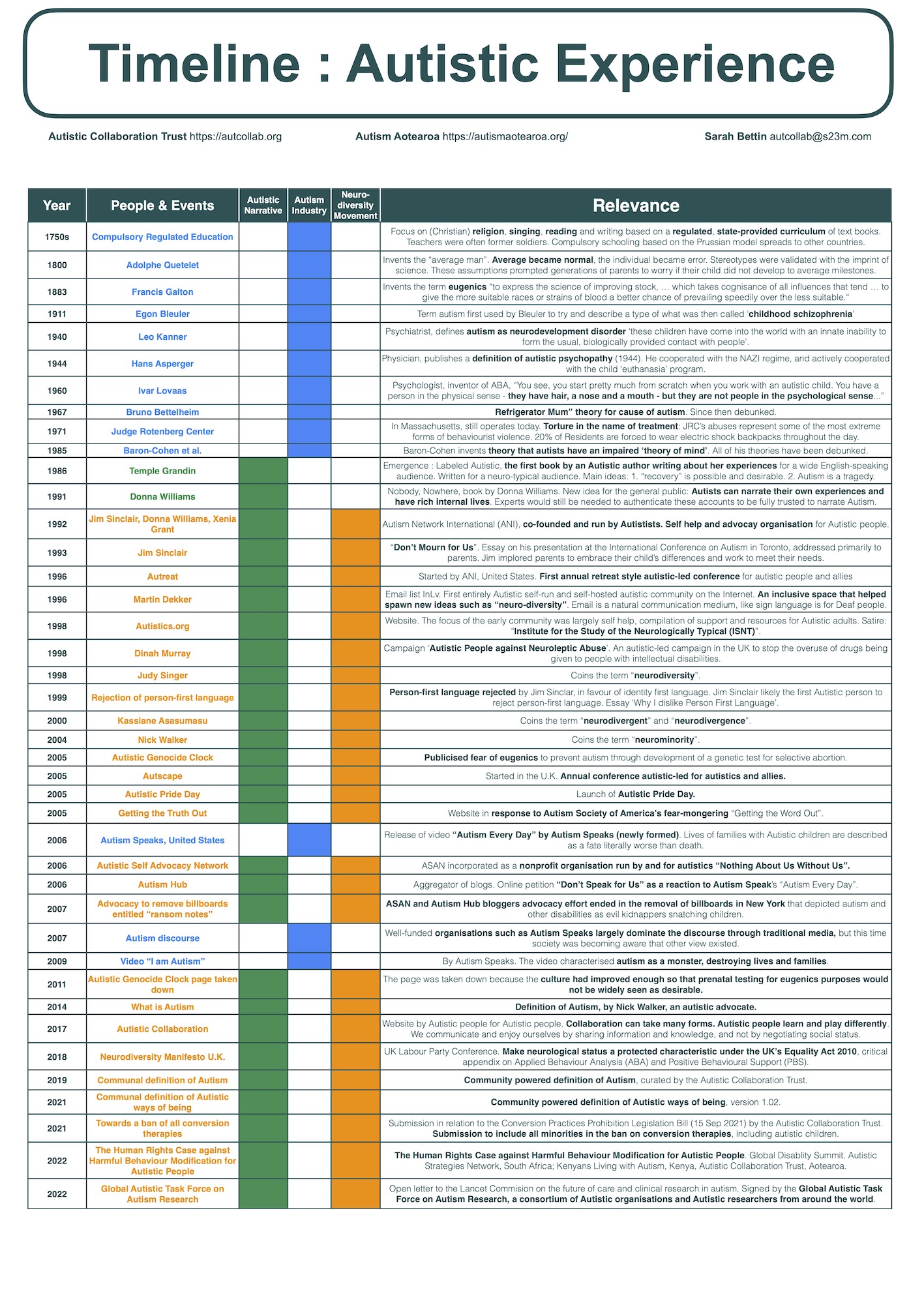
The timeline below documents the dark history of increasing levels of discrimination against Autistic and otherwise neurodivergent people that can be traced back to the early stages of industrialisation, as well as the rise of the Autistic rights counter movement in the 1990s and the wider neurodiversity movement in the 2000s.

Now is the time for the governments all around the world to act and to look into the harmful effects of all forms of “conversion therapy”, and to start undoing some of the damage by actively supporting and appreciating the cultural value of Autistic and otherwise neurodivergent ways of being.

The time for change is now.

Education about Autistic culture, the ND paradigm, and the ND movement – for medical professionals, by Autistic people

Join Autistic people from all over the world, committed to the de-stigmatisation of Autistic ways of being and other forms of neurodivergence, in support of the development and delivery of education about Autistic culture, the neurodiversity paradigm, and the neurodiversity movement – for medical professionals, by Autistic and otherwise neurodivergent people. Fill in the form below to sign.

The Autistic Collaboration Trust centres the lived experience of Autistic people in the education of healthcare professionals about Autistic ways of being and Autistic culture. All our educational work in the healthcare sector adheres to the Design Justice Network Principles and is envisioned to catalyse the adaptation of healthcare services to the specific needs of Autistic people and corresponding improvements in health outcomes.

The course Introduction to the Neurodiversity Paradigm and Intersectionality is an interactive “deep dive” into neurodiversity and autistic culture. It is creative, collaborative, and goes beyond the usual medical and workplace neurodiversity ideas. Very refreshing to take part in CPD catering to different learning and communication styles. It was the most fun I’ve had in CPD this year! The course book is beautiful.

Dr Sarah Bernard FRACP, Australia

If you are Autistic or otherwise neurodivergent, you can add your name to underscore the urgency for Autistic led education based on lived experience. If you are a healthcare professional, you can add your name to demonstrate your commitment to removing the social stigma frequently encountered by Autistic or otherwise neurodivergent colleagues and patients.

Sign

The level of ignorance, stigma, and open hostility that Autistic patients and Autistic healthcare professionals regularly have to deal with is traumatising. There is a need for healthcare sector wide education in the neurodiversity paradigm, the neurodiversity movement, and Autistic culture. Education on these topics is essential for addressing entrenched problems of lack of cultural and psychological safety in the workplace. There are also corresponding problems of lack of safety for patients, their whānau / families and communities.

Education about the neurodiversity paradigm and intersectionality is not the same as education about neurodiversity. It answers an important question:

  • How does the mindset and language of the new paradigm differ from the language in the old paradigm?

Education about the neurodiversity movement builds on the neurodiversity paradigm. It answers three important questions:

  • Why is there an urgent need for a paradigm shift?
  • Who is involved in the shift?
  • Who must learn from the neurodiversity movement?

Education about Autistic culture builds on the results of the neurodiversity movement. It answers three important questions:

  • What is Autistic culture?
  • How does it relate to other cultures?
  • How does it relate to the neurodiversity movement?

I care deeply about the healthcare outcomes of patients and about the cultural and psychological safety of all patients and all healthcare professionals within clinical environments. I recognise an urgent need for education about the cultural contexts, sensory profiles, diverse needs, and the social stigma frequently encountered by Autistic and otherwise neurodivergent people.

In particular, healthcare professionals must be introduced to the non-pathologising and non-stigmatising language that has become the expected default within Autistic culture and within the broader neurodiversity civil movement that emerged out of the Autistic rights movement. The required education is very different from education framed in the culturally outdated language of the pathology paradigm, which still presents and rates the humanity of neurodivergent people in terms of deficits relative to the current neuronormative culture.

I support the work of the Autistic Collaboration Trust to facilitate education in the neurodiversity paradigm, the neurodiversity movement, and Autistic culture based on lived experience.

← Back

Education about Autistic culture, the ND paradigm, and the ND movement

Many thanks for your support! If you are Autistic and would like to contribute to the development of educational material based on lived experience, please contact our education team at https://autcollab.org/projects/education-in-the-neurodiversity-paradigm-the-neurodiversity-movement-and-autistic-culture/.

Scope of required education

The neurodiversity paradigm

Education about the neurodiversity paradigm and intersectionality is not the same as education about neurodiversity. It answers an important question:

How does the mindset and language of the new paradigm differ from the language in the old paradigm?

Topics:

  1. Motivation
  2. Terminology
  3. The social model of disability
  4. Dimensions of divergence from neuronormativity
  5. Intersectionality
  6. Autistic ways of being and the LGBTQIA+ kaleidoscope
  7. Autistic ways of being and ADHD ways of being
  8. The communal definition of Autistic ways of being / Takiwātanga
  9. Anthropological background
  10. Exposing the cultural bias of normality
  11. The role of the Diagnostic and Statistical Manual of Mental Disorders
  12. Transdisciplinary understanding of human learning and wellbeing
  13. The connection between neurodiversity and creativity
  14. Ableism and lived experience
  15. Frequently asked questions

The neurodiversity movement

Education about the neurodiversity movement builds on the neurodiversity paradigm. It answers three important questions:

  • Why is there an urgent need for a paradigm shift?
  • Who is involved in the shift?
  • Who must learn from the neurodiversity movement?

Topics:

  1. Historic background
  2. Cultural bias against creativity, critical thinking and transdisciplinary collaboration
  3. What is happening in the neurodiversity movement right now
  4. Behaviourism in parenting, education, workplaces, economics, and the sciences
  5. Disability in a sick society
  6. Cultural safety and the human rights perspective
  7. Psychological safety
  8. What therapies and medical practices do Autistic adults consider unsafe / safe / useful?
  9. Autistic communities
  10. Towards comprehensive bans of conversion therapies
  11. Overcoming cultural inertia in a time of exponential change
  12. Design BY and WITH neurodivergent people
  13. Advice process
  14. Introduction to Open Space as a transformational tool
  15. Guidance for making good use of Open Space
  16. Critical thinking tools for creative experimentation

Autistic culture and lived experience

Education about Autistic culture builds on the results of the neurodiversity movement. It answers three important questions:

  • What is Autistic culture?
  • How does it relate to other cultures?
  • How does it relate to the neurodiversity movement?

Topics:

  1. Discovering Autistic way of being
  2. Autistic language
  3. Learning without imitation
  4. Autistic collaboration
  5. Competency networks
  6. Minimising misunderstandings
  7. Exposing social injustice
  8. Raising healthy children
  9. Creating thriving communities
  10. Towards mutual understanding and a better world
  11. Difference drives humanity forward
  12. Autistic clinicians, nurses, social workers, lawyers, accountants, scientists of all stripes, mathematicians, artists, musicians, engineers, and entrepreneurs
  13. Deep innovation
  14. Evolutionary design

For paediatricians

  1. What do paediatricians need to know about Autistic culture?
  2. What do Autistic people want paediatricians to know?
  3. What books could a paediatrician or parent read if they wanted to learn more?
  4. Other useful resources for paediatricians and parents

Autistic trauma

Education about the many ways in which Autistic people are traumatised throughout their life by the social norms and “normal” living conditions in modern industrialised societies. It answers three important questions:

  • Why are Autistic people severely affected by traumatising conditions and events?
  • How to distinguish between Autistic traits and trauma coping mechanisms?
  • How to best support highly traumatised Autistic people?

Topics:

  1. Sensory overload
  2. Physical symptoms of dis-ease
  3. Mental symptoms of dis-ease
  4. Traumatising diagnostic experiences
  5. Industrialisation and W.E.I.R.D. social norms
  6. Trauma caused by coercive techniques
  7. Trauma caused by social power gradients
  8. Trauma caused by group identities
  9. Avoiding and healing from hypernormalisation
  10. Avoiding and healing from reductionism
  11. Avoiding and healing from behaviourism
  12. Avoiding and healing from bullying
  13. Avoiding and healing from othering

Signatories

Last update: 19 July 2022

Healthcare professionals

  1. Dr. A. Ann Emery, Allied health professional, Psychologist, Canada
  2. Dr. Alan Beach, PhD, LCSW, LMFT, Allied health professional, Clinical Social Work & Family Counseling/Psychotherapy, United States
  3. Aly Dearborn, LMFT, Allied health professional, Psychotherapist, United States, Autistic
  4. Amanda Curran, Allied health professional, Australia
  5. Amanda Hart, Nursing professional, S a c t nursing sister, United Kingdom, Autistic and otherwise neurodivergent
  6. Amber Lane, Allied health professional, United Kingdom, Autistic and otherwise neurodivergent
  7. Ana Karemy López Cortes, Licenciatura, Healthcare administrator, psicologa, México, Autistic and otherwise neurodivergent
  8. Andrea Afonso, Physician, Portugal
  9. Andrea Beres, Allied health professional, Psychologist, Australia
  10. Annette Collins, Allied health professional, Australia
  11. Ariel Lenning, Physician, Optometric physician, Optometry, United States, Autistic
  12. Dr. Ashley Dubin, PhD, Allied health professional, Psychology, United States, Otherwise neurodivergent
  13. Brannen Clark, Allied health professional, United States, Autistic
  14. Becki Woolf, Allied health professional, United States
  15. Brian Hess, Allied health professional, United States
  16. Brian Moran, Nursing professional, United States
  17. Carol Beatty, Allied health professional, Counsellor, Couples’ Therapist, United Kingdom
  18. Casey Wilson, Allied health professional, United States
  19. Cecilia Barbosa, Allied health professional, United States
  20. Chanlynn Liao, Allied health professional, Speech-language Therapist, United States
  21. Chelsea Mongan, Nursing professional, Nurse Practitioner, United States, Autistic and otherwise neurodivergent
  22. Doraine Raichart, Allied health professional, United States, acupuncturist and Eastern medicine practitioner
  23. Elizabeth Williams, Allied health professional, United States, Autistic and otherwise neurodivergent
  24. Emma Ward, Allied health professional, United Kingdom
  25. Fernando Rodríguez, Allied health professional, España
  26. Heather King, Allied health professional, Speech-Language Pathologist, Australia, Autistic
  27. Holly Sprake-Hill, Allied health professional, United Kingdom, Otherwise neurodivergent
  28. Ian Reid, Nursing professional, United Kingdom
  29. Ioannis Voskopoulos, Allied health professional, Greece, Otherwise neurodivergent
  30. Iuliana Sava, Allied health professional, Psychologist, United Kingdom, Autistic
  31. Jess Hodges, Allied health professional, Psychotherapist, Australia, Autistic and otherwise neurodivergent
  32. Jessica Kitchens, Allied health professional, Mental Health, AA Therapist and Advocate, United States, Autistic and otherwise neurodivergent
  33. Jessica Newland, Allied health professional, United States, Autistic and otherwise neurodivergent
  34. Jonathan VanLandingham, Nursing professional, Registered Nurse, United States, Autistic and otherwise neurodivergent
  35. John Finnegan, Allied health professional, United States
  36. Julie McCarthy, Allied health professional, Australia, Otherwise neurodivergent
  37. Kali Rees, Allied health professional, United Kingdom
  38. Karen Scorer, Allied health professional, United Kingdom
  39. Katrina Fiebig, Allied health professional, Patient/Family Advocate, Psychiatry, Nursing professional, United States
  40. Kristen Ipson, Allied health professional, Speech-Language Pathologist, United States, Otherwise neurodivergent
  41. Lauren Lopez, Nursing professional, LPN, RN, Public Health, United States, Autistic and otherwise neurodivergent
  42. Luke Shobbrook, Allied health professional, Counselling Psychologist, Psychology, Jersey
  43. Maija Mills, Allied health professional, Physiotherapy, Canada, Autistic
  44. Marie Manalili, Allied health professional, Speech/Language Pathologist, Philippines, Autistic and otherwise neurodivergent
  45. Marta Louise, Allied health professional, Canada, Autistic and otherwise neurodivergent
  46. Dr. Megan Anna Neff, Allied health professional, Psychology Resident, United States, Autistic and otherwise neurodivergent
  47. Meredith Thompson, Allied health professional, Licensed Independent Clinical Social Worker, Social work, United States, Otherwise neurodivergent
  48. Miah Pavlik, Nursing professional, United States, Autistic
  49. Miranda, Nursing professional, Canada, Autistic and otherwise neurodivergent
  50. Monica Boyd, Healthcare administrator, Education, Canada
  51. Nicola M, Allied health professional, United Kingdom, Otherwise neurodivergent
  52. Nicole Lui, Allied health professional, Certified Functional Nutritionist (FNLP, CFNC), Medical Cannabis Consultant (AAFP-EC), Clinical Herbalist (TCM & Western Herbology, working towards board certified), and Spiritual Teacher, Canada & Hong Kong, Autistic and otherwise neurodivergent
  53. Dr. Patricia Burkhart, Physician, Radiologist, United States, Autistic
  54. Paula Gómez, Allied health professional, Australia, Otherwise neurodivergent
  55. Raphael de Miranda Luz Trindade, Physician, Portugal, Autistic
  56. Sandy Rayman, Allied health professional, Therapist, United States
  57. Sara Schultz, OD, Physician, optometrist, United States
  58. Stephanie Warm, Allied health professional, psychotherapist (LCSW), United States
  59. Svanhildur Svanvarsdottir Kristjansson, Allied health professional, Autism consultant, Speech Language Pathologist – TEACCH advanced certified consultant, United States, Otherwise neurodivergent
  60. Tara O’Donnell-Killen, Allied health professional, Ireland, Autistic
  61. Dr. Terry Hannan, A/Professor, Physician, General Internal Medicine and eHealth, Australia
  62. Tonya Makar, Allied health professional, United States, Otherwise neurodivergent
  63. Tracey Nelson, Allied health professional, Australia
  64. Vanessa MacKay/ OT, Allied health professional, United States, Otherwise neurodivergent
  65. Dr. Zoe Raos, Gastroenterology, Physician, Aotearoa New Zealand

Patients

  1. Alden Blevins, United States, Autistic and otherwise neurodivergent
  2. Alix Latta, United States, Autistic
  3. Ama Love, United Kingdom, Autistic and otherwise neurodivergent
  4. Amanda Sutton, United Kingdom
  5. Bailey Wagner, Canada, Autistic and otherwise neurodivergent
  6. Brina Simon, United States, Autistic and otherwise neurodivergent
  7. Candace Jordan, United States, Otherwise neurodivergent
  8. Caroline Kimrey, United States, Autistic and otherwise neurodivergent
  9. Catherine Andrews, United States, Autistic and otherwise neurodivergent
  10. Dan McFarland, United States, Autistic and otherwise neurodivergent
  11. Daniel Aird, Senior Research Associate (Biotech / cancer field; but am very well versed in science), United States, Autistic and otherwise neurodivergent
  12. Heather Johnson, Writer, United States, Autistic and otherwise neurodivergent
  13. Heather Steeves, United States, Autistic and otherwise neurodivergent
  14. Herman Langkamp, Nederland, Autistic
  15. Jacki Edry, Author, educator, advocating for neurodiversity and inclusion, parent of neurodivergent children, Israel, Otherwise neurodivergent
  16. Jax Bayne, United States, Autistic
  17. JC John Sese Cuneta, Philippines, Autistic
  18. Jessica Nabb, Australia, Autistic
  19. Kae Peterman, United States, Autistic and otherwise neurodivergent
  20. Karen Sydow, Australia, Otherwise neurodivergent
  21. Khaenin Rutherford, United States, Otherwise neurodivergent
  22. Linda Guevara, Mexico, Otherwise neurodivergent
  23. Lisa W, United States, Autistic and otherwise neurodivergent
  24. Lucy Reid, United Kingdom, Autistic and otherwise neurodivergent
  25. Liz Pine, United States, Autistic
  26. Martin Bryan-Tell, United States, Autistic and otherwise neurodivergent
  27. Matthew R, United States, Autistic and otherwise neurodivergent
  28. Meg Bradshaw, Canada, Autistic and otherwise neurodivergent
  29. Natasha Trotman, United Kingdom
  30. Rachel Millar, Australia, Otherwise neurodivergent
  31. Rachel Morton, United States, Autistic
  32. Renata Moreno, Chile, Autistic and otherwise neurodivergent
  33. Rome Icasiano, United States, Autistic
  34. Ryan Boren, United States, Autistic and otherwise neurodivergent
  35. Stephen Dooley, United Kingdom, Autistic and otherwise neurodivergent
  36. Suzanne Galloway, Australia, Autistic and otherwise neurodivergent
  37. Sydney Warner, United States
  38. T. Purk, ASD Researcher and Educator, United States, Otherwise neurodivergent
  39. Traci Collins, United States, Autistic
  40. Victoria Busuttil, United Kingdom, Autistic and otherwise neurodivergent
  41. Wendy Garfield, United States, Otherwise neurodivergent

Autistic ways of being, trauma, and diagnosis

Living in our global industrialised society is traumatising, especially for hypersensitive Autistic people, and this has increasingly been the case since the earliest days of industrialisation, even before the term “autism” entered the vocabulary of the medical profession.

Adults seeking a diagnosis of autism are often looking for an explanation of their lived experience, which often includes highly traumatic experiences, in many cases starting in childhood. Parents seeking a diagnosis for their child are typically driven by the fear that their child won’t be able to “succeed” in the competitive world of so-called education, jobs, careers, and social status.

A global multi billion dollar autism industry has been built on the backs of Autistic people and is critically dependent on the ongoing traumatisation of Autistic people. This is glaringly obvious in terms of the perpetuation of traumatising behaviourism that is sold as a “treatment for autism” to the parents of Autistic children, but it is not always quite as obvious in relation to the “treatment” of Autistic adults.

Discrimination against Autistic people is comparable to the level of discrimination against LGBTQIA+ people 50 years ago. The pathologisation of Autistic ways of being has led to what some critical researchers refer to as the Autism Industrial Complex.

In this discriminatory cultural environment, many services from the autism industry must be considered unethical, and obtaining a diagnosis can be an invitation for potential abuse and exploitation, as illustrated in the account of adult diagnostic experience in Australia below. Even the most well meaning diagnostician will produce “offical” documentation that is coded in pathologising language.

Trigger warning: if you are currently keen on obtaining an official diagnosis of autism, the account of abuse and diagnostic trauma below may prompt you to rethink, and draw your attention to the Communal Definition of Autistic Ways of Being.

Regardless of diagnostic status, the account below should prompt all Autistic people

  1. to question the value of official diagnosis,
  2. to consider the value of Autistic peer support networks,
  3. and to focus on what can be achieved by co-creating healthy Autistic communities.

An anonymised diagnostic experience

Surviving professional abuse accompanying autism diagnosis

Letter to the psychologist who in diagnosing my Autism simultaneously assumed the entitled right to abuse me:

Survivors are quiet because they are haunted, because they still cannot entirely accept what happened. Khan, Ausma Zehanat (2017) The Unquiet Dead, UK, Oldcastle Books Ltd

“Tony Attwood, an acknowledged expert on the autistic spectrum, writes that there is a ‘quasi-philosophical quality’ to the autobiographies of adults with Asperger’s analysis’. What he is referring to is generally accepted to be an over-rationalistic, hyper-reflexive self-awareness, and a disengagement from emotion and embodied existence, which is very much in accord with my experience of looking after subjects on the autistic spectrum. Moreover, there is an abstract, quasi-philosophical mode of talking that is common in some kinds of schizophrenia, at first impressive, but ultimately recalcitrant to understanding; it is sometimes actually referred to as ‘pseudo-philosophical thought disorder’. Both autistic and schizophrenic individuals have an antipathy to what is embodied, uncertain and unknown (or unknowable), preferring what is abstract, certain and known, all of which is characteristic of the left hemisphere.” McGilchrist, Iain (Nov 2021) The Things that Matter: our brains, our delusions and the unmaking of the world, London UK, Perspectiva

I first read the above McGilchrist quote in December 2021, with awe. I recall thinking, what confident audacity for the author and Tony Attwood to expose their un/conscious bias, their subjective gaze, their neuronormativity so publicly in the year 2021 for all the world to witness. And then I realised in breathtaking shock, they suffered no risk. I was naïve. Theirs is the populist imagination of the fearful conspiracy theorists. It is we Autists who continue to be the ones at risk as they perpetuate their dehumanization of the neuro-other. (These comments will apply equally to schizophrenics I suspect, but I would need to ask a Schizophrenic human to truly know that.)

I still find it unbelievable that old white men still exercise such power and authority in the 21st century. They are both around my age as it happens. Yet I shouldn’t be surprised; pragmatically I realise their narrative has a long tradition of attracting unquestioning followers waiting in line for a share of their empires; power and prestige are very seductive. And then there is the opportunity to accrue wealth; it turns out the Autism Industry is a great money spinner. Too many reasons to dehumanise; none of any value to not.

However, in 2018 I did not know this form of confidently overt Ableism still thrived; I was undoubtedly ignorant. I did not know careers were still being built and fortunes being made on the backs of Autistic humans. I wasn’t looking for Ableism, but neither was I looking for Sexism, Misogyny, Homophobia and/or Ageism. (In hindsight I can comfortably assume Racism and Transphobia would have also presented if I had been a POC and/or Transgender.) I was so naively confident I was safe that I walked into your offices alone; I believed I was merely undertaking a series of objective tests. It never occurred to me in my wildest dreams that I would not be safe from/with you.

I had not long turned 67 when I first walked in your door. At that time, I had little insight into what it meant living an undiagnosed Autistic life as a woman; but you did. Autism continues to be your advertised area of expertise.

What I do continue to know is that statistically few women can reach my age without experiencing some forms of abuse, particularly Violence Against Women (VAW). What I do continue to know is that Women with Disabilities face a far greater risk, experience VAW at a far higher rate. Given the political and media attention to VAW and abuse of people with disabilities this century, it was/is surely not possible for you to be ignorant of its ubiquitous nature unless you deliberately chose to wear blinkers.

Given what I assume you knew (and know) about the incidence of domestic/family/sexual abuse among Autistic Women and Girls, diagnosed and undiagnosed, it can hardly have been an earth-shattering surprise that I revealed in response to your questions in that first session, a history of domestic/family abuse.

Given what I assume you knew (and know) about the incidence of domestic/family/sexual abuse among Autistic Women and Girls, diagnosed and undiagnosed, then you surely must have been trained in how to respond appropriately to such revelations. Training: Trauma Counselling; Managing exposures of Domestic/Family Abuse in the counselling room; Privacy and Confidentiality; Client Safety.

Because in 2018 I was blind to your Ableism, I experienced your abuse primarily as Sexism, Misogyny, Ageism and Homophobia. Now all those may be true also. Most likely were/are. But what I hadn’t considered from your worldview was/is that they may all be subcategories of your Ableism. Or that they were/are inextricably enmeshed with your Ableism.

I am astonished that in 2022, our society and economy continue to be controlled by a culture of patronising paternalism in a hierarchy determined by intersections of race, class, gender, wealth, the list goes on. This is utopian naivete on my part because equality is popularly delivered as the democratic narrative when in reality the survival of extant democracy requires equality to be non-existent, only illusional. I wonder if that is why paternalism seems mistaken for emotional maturity by a passive majority, because we are encouraged to see the world through rose-coloured lens; it may explain the current popularity of daddy politicians around the planet. Whereas it is the reverse. Emotional maturity rather requires self-awareness, compassion and empathy. Paradoxically, while we live in a culture which encourages dependency on a self-appointed minority perceived as “experts”, our “experts” will never gain emotional maturity.

I am labouring the point of emotional maturity as in 2018, I was struck by its absence in your language and presence. Even today when I recall your voice, I hear that of an earnest little boy. You were so young, younger than my own sons. But even then, I wasn’t alarmed as I trusted your professional training should have compensated for your youth; it could even have been an advantage. It is a somewhat humorous fact of life that as you age you become more aware of the youth of working people around you and you need to learn to accustom yourself to that reality. Thus, I entered your office with increasing hope that a young man could be more aware and not mansplain a woman as an older man might.

Consequently, I was caught totally unawares when your primary narrative to address me after the first session was Shaming and Blaming Coercive Control. I would have corrected my children for speaking to another, including me, in that manner. I would have called it out for what it was: Disrespectful and Abusive. It is the language only one of my children ever tried as an adult, and that was when he wanted to manipulate and bully from me something to which he wasn’t entitled. I just had too many frameworks from which to try and comprehend your behaviour: emotional immaturity, sexism, misogyny, ageism, homophobia, classism, poverty, single mother stereotypes, or some combination of some, or a combination of all.

I am now 71. One of the experiences of ageing is the illusion that time is passing at an escalating speed. In some ways, that is an existential truth as the presence of death hovers ever closer in mathematical probability. Thus, as I age, there is an increasing sense of urgency to gain increased insight into the dynamics of your abuse in 2018. And I have been wondering how that might be possible.

I wonder what happens when my experience of your abuse metamorphoses into another where as many as possible of the toxic stereotypes you embraced, except maybe your Ableism, are written out. Is it possible to create a hypothetical scenario to explore if it takes the client to the same place you took me: Denied Humanity? The most commonly accepted example that most closely resembles the experience of the domestic/ family violence victim-survivor is that of the War Veteran with PTSD.

So here goes. I address this to you, my professional abuser, where the word “professional” is a pun, carries the double entendre of your self-perception as a professional as well as being an expert abuser. It is in this extraordinary, detached retelling that I am realising how severely you abused me.

Imagine:

Imagine a “white” middle-aged heterosexual man,
professionally attired, open-necked shirt, chinos and loafers,
straight backed, slender, physically fit deportment,
well spoken, well educated,
gentle quiet demeanour,
firm in his convictions and confidence,
self refers to your office for Autism assessment.

He attends alone
a little nervous understandably
but feeling confident safe and trusting
believing there is no reason for concern
seeking answers with open curiosity,
after meeting serendipitously
and a brief ensuing conversation with an Autistic man.

In the first of the four sessions, the introductory session, you learn:
His parents are deceased, he has no siblings (only child).
He and his ex-wife separated and divorced many years ago.
They had no children.
He has been living alone since his marriage ended.

He also reveals to you
he is a retired high-ranking army officer (let’s say major or captain) and
completed his university education as a civil engineer
while in the Australian Defence Services.

In response to your questions about his army career
you learn he was deployed to two terms of service in a war zone
as an active soldier and officer

You ask: Where? What country? What war?

He replies: It doesn’t matter what country or what war. Witnessing the atrocity of war is witnessing the atrocity of war.

You ask: What was your experience of war?

He replies: I saw enough to return with PTSD. War Veterans are highly probable to return with PTSD. I am no different. You see things you can never unsee. Things that inhabit your worst nightmares.

You ask: When did this happen? What years?

He replies: When? 1990s? 2010s? Why does that matter. It is irrelevant.

You ask: Have you recovered from your PTSD?

He looks at you bewildered; his look says “You ARE a qualified psychologist, aren’t you? Did you really ask that idiotic question?”

Did you catch that look?

He smiles gently and explains: There is no such thing as full recovery from PTSD. The scars are permanent. Healing is modifying your life as you painfully learn to care for your emotional scars. You recreate your life.

You don’t acknowledge that answer.

Reluctantly into your unresponsiveness, evoking his own embarrassment and shame, he adds: I was also a POW for some time, imprisoned in isolation in deprived conditions.

You don’t acknowledge that additional information or his overtly and fearfully presented feelings.

Into the silence and your downturned head, he offers: I have become a practitioner of Zen Buddhist meditation which brings a lot of peace to my life. And Defence have provided me with a trained Companion Dog. A Golden Retriever.

You don’t acknowledge that feedback.

He smiles watching you ignore him: Her name is Irene. The Greek Goddess of Peace. She brings serenity and joy, laughter and playfulness to my life.

You don’t acknowledge that information.

Rather you say as if he hasn’t spoken: Diagnosis requires family members complete questionnaires regarding their observations of your behaviour.

He nods slowly trying to absorb, comprehend why what he thought was objective scientific tests suddenly became subjective observation. He knows how trauma fractures families. As do all War Veterans. And there is only one potential family member to contact. He waits.

You implacably demand with quiet authority: I need a family questionnaire completed by your wife.

He replies: I have already told you I am separated from my wife and as is for many returning War Vets with PTSD, our marriage ended badly. I do not want to do that. That will not be fair on her, or on me, particularly when we have had no contact for many years now. It will also be understandably impossible to obtain lack of bias from her.

You demand quietly, rigidly, without emotion: I need a family questionnaire completed by your wife.

He replies: As you believe this is necessary, I will try to find her, explain to her you need this, hope she will understand, but I ask you to acknowledge our shared history, to protect and be respectful of both of us during this process.

You do not acknowledge this response but move on.

You demand unemotionally: You need to contact your POW jailers to complete questionnaires. Can you organise that?

Now he looks very confused, asking: Why do I need to do that?

You reply quietly aloofly: Their responses are necessary for the diagnostic assessment.

He looks at you in shock, but he thinks to himself: this is your area of expertise, you must know what you are doing. Discovering if he is Autistic is very important to him as he continues trying to make sense of his life.

But still he replies: I put myself at enormous risk if I do this and the Army may well object.

You demand quietly implacably: I need their completed questionnaires.

The War Veteran replies with great fear: I will see what I can do. But I am trusting you to keep me safe. I am trusting you not to breach my privacy and confidentiality. If the Army agrees, I will arrange for them to forward their responses directly to you so I do not need to have direct contact with them; I will organise contact via a third party, via Army personnel.

Did you catch his fear? Do you see how crazy this story is becoming?

You choose not to respond to or acknowledge his feedback.

You choose not to acknowledge his fear.

You choose not to engage with him in adult/adult language, but rather infantilize him.

You choose to disrespect him and his ex-wife while simultaneously privileging her narrative.

At a later session, you will tell him: You have Alexithymia and will not explain what that means.
You will later tell him: You have no connection to your feelings, or You have no feelings, despite his exposure of his feelings in your office, his years of personal counselling, tertiary education, officer training and career.

You will tell him: You do not have empathy

And when he queries, you will tell him: You do not have real empathy.

You will tell him: You do not know who you are.

But you do not tell him whom he is.

You will order him to attend his GP ASAP, to go back on antidepressants and antianxiety medication urgently. You don’t acknowledge him informing you in a previous session that his GP has said he doesn’t need them, that he hasn’t taken them for years. His GP will be furious. With your irresponsibility.

You will order him to defer all decisions regarding his life to a young man, a defence services cadet, about 30 years younger, he has been mentoring. A young neighbour, one of the few current friends/acquaintances he has told you about in his responses to your questions about his social life.

You will choose to implacably ignore but rather, coldly observe him, the session he devolves in a trauma response of your own creation because you denied his fear and risk. You will also ignore the risk to him inherent in his presenting trauma response. You will further choose not to do any follow-up care after his trauma response to your abuse.

You will write him an unsolicited Executive Function Report in infantilizing language telling him he needs a carer as he is incapable of self-care and making his own decisions. You will do this even though he has told you that he has been living capably and independently alone since his marriage ended many years earlier. And he is a mature age adult who has a successful career behind him.

Three years later, your colleague will advise him that you wrote that document using the word-processing search-and-replace function to insert his name in place of that of a young child. In a proforma document intended for young children.

It is a letter so infantilizing and minimizing that he would never even address a child in that manner.

Three years later, your colleague will advise him that the document was “unhelpful” but that you didn’t mean to be “unhelpful”.

You will email him that unsolicited infantilizing document on a Saturday morning three weeks and five days after the fourth and final session.

In your email to him, you will not acknowledge that you are also in receipt of the email his POW jailers sent him about two hours before you sent your email. The email that his abusers also confidently sent you. He knows you have received it because your correct email address is in the cc field.

You will not feel it necessary to check in with him to ensure that he is ok after receiving both emails so close together on a Saturday morning.

You will repeatedly deny over a period of three years, despite the evidence to the contrary, ever having contact with his POW jailers.

You will tell him in writing He has lied to you about his cohabitation status. That He doesn’t live alone as he claims but is cohabiting with another person. (document forwarded late 2021, over three years post diagnosis.)

Your false accusations about his cohabitation status are so crazy that he can only wonder why make such a false accusation. Was there something you meant to say that you didn’t say?

You will tell him in writing he is “offensive” (stet) (same document forwarded late 2021)

You will shame him and trigger his internal shame. Shame is easily triggered in PTSD victim-survivors.

What you choose not to tell him:

  • You will not consider it necessary to keep him safe.
  • You will expose him to his abusers.
  • You will gift them a further opportunity to abuse him. They can hardly believe their good luck. And they will exploit their good fortune.
  • You will be manipulated by his abusers because you want to be manipulated by his abusers.
  • You will preference his jailers’ narrative over his narrative.
  • You will treat his narrative of his abuse experiences as over-emotive reactions having no validity or credibility because all PTSD victim-survivors and Autists have over-active imaginations. Or naturally deceive.
  • The narrative of his torturers and jailers will be his irrevocable truth and reality.
  • You will consider it reasonable to breach the Professional Standards of your industry; you will consider it reasonable to breach his Privacy and Confidentiality because, as he is not fully human, he is not entitled to their protection.
  • You will not tell him that the wealth-creating Autism Industry has still not surrendered its Eugenic roots, rather celebrates them.
  • You will not tell him that the Autism Industry is ableist, founded on the Medical Model of Disability. (In preference to the Social Model)
  • You will not tell him that the Autism Industry facilitates the systemic abuse of Autistic children through such practices as ABA because the Autism Industry believes Autists have no feelings.

What he will do:

  • For over three years, he will try to gain insight and healing using the tools of negotiation and mediation while simultaneously requesting staff training, contacting you, then your colleagues. He will not be successful in that endeavour.
  • He will discover that he cannot gain support for professional abuse from another psychologist or mental health worker as they close ranks with the mantra “you didn’t mean it”. That mantra is ubiquitous; it is nigh on impossible for anyone to gain professional support for professional abuse.
  • Because there is no external support available:
    • he will traumatise and retraumatise himself to process his trauma alone as his only available healing path and
    • he will read multiple texts on Trauma Recovery to enable that path and
    • he will read literature and texts about Autism written by Autistic people to educate himself about Autism and
    • he will discover that ableism is rife within the Autism Industry
  • Through his reading, he will discover that it was totally unnecessary for you to abuse and traumatise him; that professionals assess and diagnose Autism every day taking into account trauma histories of their clients; that they do not contact their abusers.
  • He will request support from the relevant State Health Ombudsman who will reply stating that
    • He is exactly 12 months too late to lodge a complaint; the cut-off date is 2 years
    • His complaint is not deemed sufficiently serious to consider investigating beyond the 2-year cut-off date and
    • They do not consider your other clients are at risk of similarly repeating abuse which would call for risk assessment and training
  • Over a period of 3 ½ years, he will attempt multiple times to gain access to all the documents in his file.
    • He will not be successful.
    • Different documents will appear at different times but only if he can name them.
    • One of the documents will make false allegations to which he has no recourse.
  • Over a period of six months in 2021, he will exchange frequent emails with two of your immediate colleagues. They will variously tell him:
    • They are not responsible for any aspect of your professional practice even though one of them was the owner of the practice at the time of the abuse
    • You were “unhelpful” but didn’t mean to be “unhelpful” (stet)
    • One will refer him back to you for resolution although
      • he has informed both colleagues he has tried this path many times before unsuccessfully and
      • your colleagues know it is not best practice or safe to refer a client back to a professional who has abused them
    • They will employ various overt tactics to silence him.

In Summary:

You will deny his truth and reality.

You will choose to abuse and traumatise him for an unstated reason.

Because you and your colleagues do not believe he is truly human and you and your colleagues believe it is also necessary for him to know he is only pseudo-human.

He is Autistic, recalcitrant to understanding, suffering from pseudo-philosophical thought disorder.

My question is: Will you abuse a War Veteran and POW victim-survivor the same way you abused a Family Violence victim-survivor? I cannot answer that question for you. I do not know your answer; only you do. But the indications are that you will as you and your colleagues believe Autistic people have no real humanity.

You know you are safe, that he has no path to redress.

You have got away with it. Successfully and easily, with minimum fuss.

What say you?

My story

i try to gain self-deprecating comic relief from your abuse
i tell others how glad I still am to receive the autism diagnosis
that was worth every hard found dollar i paid for it

but I continue to be left speechless by
your unsolicited entirely unexpected abuse
that accompanied your assessment

i know you didn’t charge me for it
you gifted me your abuse and trauma free
but … i could have done without it

four years later
i am still bewildered by its
inanity meaninglessness senselessness

four years later
i still puzzle what you got out of your abusive behaviour
authority power control ego some need to punish but punish what

you stampeded over my life
with all the privilege of a wealthy white boy
let loose in a vast lolly shop

you behaved like a spoilt indulged irresponsible child
but you were not a child
you were an adult

you executed authority
with unquestioning arrogance indifference
utterly denying the existence of family violence

you denied and exploited my history of intergenerational family violence
to feed some want of yours maybe ego
mercilessly

you shamed me
shamelessly
with no regard for my wellbeing

you disregarded my safety
with the ease and disregard that
a quake trembles and abysses the earth’s crust

you unstitched in a brief moment in time
half a century of my hard work recovering from domestic abuse
violently ripping the seams apart

you broke my trust
breached my privacy and confidentiality
with the same indifferent insignificance as snapping a slender twig underfoot

you breached with equanimity
professional ethics, member code of ethics, antidiscrimination legislation and UN human rights
while iterating to me many times you were an ethical man

you blindfolded me
set my back against a bloodstained brick wall in front of a firing squad which
you implacably orchestrated and conducted

you were
an unexpected subversive volcanic eruption
a projectile of projected toxic stereotypes

you told me I had no empathy
or no real empathy
i am still waiting to meet your empathy or your compassion

you executed
with onerous much-practiced precision
coercive control and minimization

you cast away my humanity
you erased my identity my existence
with self-righteous authority

you broke and shattered my body
scattering it atom by atom
to every corner of the universe

you accelerated my soul my essence
the length of the Large Hadron Collider and
unceremoniously dumped every particle into the endless depths of a black hole

you assigned me relentlessly
to a hell
of your own creation

you cast a swathe of chaos
through my life from which four years later
i am still trying to recover

i still struggle
to negate my internalized anger and judgmentalism
for my stupidity trusting you

i remind myself I was the client
i remind myself you were the psychologist
it was your responsibility to protect me

but don’t you worry
your prestigious colleagues believe you did the right thing denying my humanity
I checked

but four years ago
i didn’t understand why you would put choose to put my safety at risk
when I warned you of my peril

but four years ago
i didn’t know that you believe I am so valueless
you also believed it was totally reasonable to put my personal safety at risk

but four years ago
i didn’t know you chose to abuse and traumatise me
as you and your colleagues believe i am not capable of feelings

but four years ago
i didn’t know that you and your colleagues believe autistic humans
are not entitled to the protection of the professional standards of your industry

but four years ago
i didn’t know that you and your colleagues believe autistic humans
are not entitled to the protection of government antidiscrimination legislation

but four years ago
I didn’t know that you and your colleagues believe autistic humans
are not entitled to the rights of conventions set down by the united nations

but four years ago
I didn’t know you and your colleagues believe
autistic humans have no humanity no heart

but four years ago
i didn’t know you and your colleagues believe autistic humans are
pseudo humans and quasi philosophers

But four years ago
i didn’t understand that you and your colleagues believe autistic humans
are “recalcitrant to understanding” with ‘pseudo-philosophical thought disorder’

but four years ago
i believed the autism industry had moved beyond its history of eugenics.
i was wrong

your ableism your sexism misogyny ageism and homophobia
have successfully unravelled me like a carelessly knitted cardigan.
if that was your intent

congratulations, human, congratulations
you and your colleagues, succeeded where my every family member before you failed
they will all be proud of you

I am no where
I am no when
I am no one

References

Agarwal, Pragya (2020) Sway: unravelling unconscious bias, London, Bloomsbury Sigma

Ford, Ian (2010), A Field Guide to Earthlings: an Autistic/Asperger view of neurotypical behaviour, Albuquerque, Ian Ford Software Corporation

Gadsby, Hannah (2022), Ten Steps to Nanette: a situation memoir, New York, Ballantine Books
Hill, Jess (2019), See What You Made Me Do: power control and domestic violence, Australia, Black Inc (winner of the 2020 Stella prize)

Jane, Emma A (2022), Diagnosis Normal: living with abuse, undiagnosed autism, and covid-grade crazy, Ebury Press (Penguin Random House Group)

Milton, Damian (2017), A Mismatch of Salience: explorations of the nature of autism from theory to practice, UK, Pavilion Publishing

Milton, Damian (lead editor) (2020), The Neurodiversity Reader: exploring concepts, lived experience and implications for practice, UK, Pavilion Publishing

Silberman, Steve (2015), Neurotribes: the legacy of Autism and how to think smarter about people who think differently, Allen and Unwin

Sosa, Lorena (2017), Intersectionality in the Human Rights Legal Framework on Violence Against Women: at the centre or the margins? UK, Cambridge University Press

Professional Standards in Australia

Antidiscrimination legislation in Australia

United Nations

Violence Against Autistic Women and Girls and People with Disabilities

Open letter to the Lancet Commission on the future of care and clinical research in autism

14th February 2022

We wish to address the Lancet Commission on the future of care and clinical research in autism on behalf of the Global Autistic Task Force on Autism Research, a committee comprising autistic advocates, researchers and representatives of organisations by and for autistic people. 

As the Commission emphasised the importance of collaborative participation, we look forward to being included as collaborators. We appear to have remained largely invisible, generalised briefly as ‘the neurodiversity movement’.

It is encouraging that the need for system change and the value of neurodiversity were recognised by the Commission. However, some omissions contradict this message. Studies mapping autistic people’s priorities regarding research were not mentioned. Participatory research was mentioned but not defined, nor was literature on its principles cited.

We find the proposal to adopt the term ‘profound autism’ highly problematic, as well as the overall emphasis on behavioural interventions, excluding more recent, promising approaches. We disagree with the recommendation to focus clinical research on randomised controlled trials for short-term interventions, including medication and behavioural trials. 

To improve autistic lives, we need concepts developed by autistic scholars applied to clinical research. We need research on causes of mortality, access to health care, and improving mental health support. We need research on screening and diagnosis for all countries, and the health consequences of system factors: discrimination, mistreatment, poverty and lack of access to appropriate services. We need closer involvement of autistic people to ensure that clinical trials are truly ethical, and to curb the development of pseudo-treatments.

We call for shared, accessible platforms to continue the discourse and start building collaboration.

Signatories

(country codes in parentheses)

European Council of Autistic People (EUR)Heta Pukki (President)
Martijn Dekker (Board member)
Autistic Self Advocacy Network (INTL)
Collectivo Autista Mi Cerebro Atípico (INTL)Bárbara Herrán (CEO)
Autistic Doctors International (INTL) Mary Doherty (ADI Founder)
Sebastian Shaw (ADI Research Lead)
Sue McCowan (ADI Psychiatry Lead)
Participatory Autism Research Collective (UK)Damian Milton (Chair) 
Autismus-Forschungs-Kooperation (DE)Silke Lipinski (for the working group)
Autistic Collaboration Trust (INTL)Jorn Bettin (Chairperson)
Quinn Dexter (Advisory Board Member)
Lees- en Adviesgroep Volwassenen met Autisme (BE)Jo Bervoets
Autism Rights Group Highland (UK)Kabie Brook (Chairperson)
Joshua Hennessy (Assistant Chairperson)
Asociación Autistas de Colombia (CO)Monica Vidal Gutierrez
The Autistic Realm Australia Inc. (AU)Kylieanne Derwent (Co-Founder & Vice Chair)
estas, Adult Autistic Self-advocacy Meeting (KR)Yoon, wn-ho, Jang Jiyong (Co-moderators),
Onemoo Lee
Asociația suntAutist (RO)Ovidiu Platon (Chair)
Suomen Autismikirjon Yhdistys (FI)Minna Brockmann (Chairperson)
Annikka Suoninen (Project Coordinator)
PAS Nederland (NL)Tammo Michel (chairperson / secretary)
Otoemojite (neurodiversity self-help group)(JP)Satsuki Ayaya
CLE Autistes (FR)Garance Jacquot (Secretary) for the Board
Autisme- og Aspergerforeningen for Voksne (DK)Nina Catalina Michaelsen (Chairperson) 
Silke Rudolph (Board Member/Treasurer) 
Inicijativa za autizam i ostale neurodivergentnosti,
samozastupanje i kulturu različitosti ASK
(autistic initiative)(HR)
Kosjenka Petek, Sunčica Lovrečić Čekić
Aspies e.V. (DE)Hajo Seng, Rainer Döhle (Chairs)
Autistics Unmasked (US)Heini Natri
Adventor o. s. (CZ)Michal Roškaňuk (Chairman)
A-komunita (CZ)Vojta Bartošík (Chairman)
Asociación Autistas de Mexico (MX)Yadira Garcia Rojas (President)
Giovanna Villarreal Estrada ( Secretary)

References

organisationlink
EUCAPhttps://eucap.eu/2022/02/14/open-letter-to-lancet-commission
ASAN
Mi Cerebro Atípicohttps://www.facebook.com/527565417690268/posts/1375175466262588/(Spanish)

https://twitter.com/Cerebro_Atipico/status/1493196115096842241 (Spanish)
PARC
AFK
Autistic Doctors International
Autistic Collaboration Trusthttps://autcollab.org/2022/02/14/open-letter-to-the-lancet-commission/
LAVAhttps://lavautisme.wordpress.com/2022/02/13/open-brief-14-2-2022/
ARGH
Asociacion Autistas de Colombiahttps://www.facebook.com/100442532355847/posts/152930233773743/(Spanish)https://www.facebook.com/100442532355847/posts/152930483773718/(English)
TARAwww.tara.org.au  
estas
suntAutisthttps://www.suntautist.ro/viitorul-ingrijirii-si-cercetarii-clinice-in-autism-scrisoare-deschisa-catre-comisia-lancet/
Suomen Autismikirjon Yhdistyshttps://asy.fi/avoin-kirje-lancet-komissiolle
PAS Nederlandhttps://www.pasnederland.nl/home/open-brief-aan-de-lancet.html 
Otoemojitehttps://otoemojite.com/20220214openletter/ 
CLE Autisteshttps://asso.cle-autistes.fr/lettre-ouverte-a-the-lancet-autisme-profond/
AAFVhttps://aspergerforeningen.dk/nyheder/2205/aabent-brev-til-the-lancet-commission-on-the-future-of-care-and-clinical-research-in-autism
ASKhttps://www.atipicni.hr/nista-o-nama-bez-nas/
Aspies e.V.https://aspies.de/offener-brief-zu-einem-autismus-artikel-der-lancet-kommission/
Autistics Unmasked
Adventor
A-komunita
Agrupación Pregúntale a los adultos autistashttps://www.facebook.com/groups/respuestasdeautistas/
Autista Construyendo https://www.facebook.com/AUTISTACONSTRUYENDO/posts/488768579439403 (Spanish)
Asperbuhohttps://www.facebook.com/AsperBuho1090/posts/1292785927867616 (Spanish)
Con estilo autistahttps://www.facebook.com/ConEstiloAutista/posts/469504724818250 (Spanish)
Aprender A Querermehttps://www.facebook.com/aprenderaquererme/posts/359307272863356
Neuropeculiarhttps://neuropeculiar.com/2022/02/14/lettera-aperta-alla-commissione-lancet/

The Autistic pace of life in the ocean

Thanks to wonderful Autistic conversations I think I am beginning to understand why I feel so much at home in the ocean. To date I had not connected it to healing from Autistic trauma, but now I see the connection with increasing clarity.

Firstly, that much I knew already, besides the air and remote mountain regions, the ocean is one of the few environments that at least superficially is not shaped by humans. But of course in terms of pollution and pH, and in terms of the growing number of fish farms, this is no longer true.

Secondly, and this is the part I am only fully realising as part of Autistic dialogues, the pace of life in the ocean is much more in tune with a pace that is compatible with humans cognitive capacities and limits than life in human urban environments.

Let me explain:

The universal law of underwater movement

The density of water (800 times higher than air) means that drag is very significant, which means that all living creatures move much slower in water than on land. Also any jerky movements only cost extra energy. Underwater life is about going slow and making smooth movements, or simply staying still, observing the environment with all your senses. You can learn how to do it by observing the fishes around you.

You learn the universal law of movement intuitively. You learn how to not disrupt the flow of life. Any fast movement, and whatever you were curious about has disappeared into a crack in the reef, or is moving away from you with streamlined bodies that are several times faster underwater than any human, fast disappearing beyond your limited horizon of visibility. Moving fast underwater amounts to a violation of a law of nature. You are immediately recognised as a threat.

All you need to do to be part of the life of the ocean is to slow down and follow the universal law of underwater movement.

For me the universal law of underwater movement has become associated with the feeling of being at home. This feeling is reinforced by the taste of salt water. If I have an addiction it is the addiction to being immersed in water and tasting salt water.

I think for Autistic people the universal law of underwater movement acts as the braking assistant/buddy that we so often lack in W.E.I.R.D. human social environments.

The ocean environment has healing properties for Autistic people.

Orientation and proprioception in the ocean

Because the human body consists mostly of water, i.e. has the same density, you don’t notice any difference in blood pressure in your head, no matter which way you are oriented. Any position is just as comfortable as any other.

You are floating in space, completely effortlessly. This only reminds you to literally take it easy, and to go slow, because the high level of drag means that there is absolutely no point in attempting to go fast, especially if you have a SCUBA tank on your back – which weighs nothing, but which slows you down with further drag.

When you are free-diving it is even more important to go slow, because you can go much further/deeper by going slow – attempting to go fast only increases oxygen consumption and limits your range. A corollary of the universal law of underwater movement:

Underwater, less effort lets you travel farther!

Vision and scope of visibility in the ocean

Visibility is often limited to less than 10m, sometimes much less, and at the very best 40 metres. This means the visible world is small.

Brightness and contrasts are rapidly reduced with increasing depth. The world starts to look very different 10m below the surface and beyond. Blue becomes the dominant colour, and even if you look up, the source of light from the surface is very pleasant to look at, never too bright.

Also water tends to feel cooler than air. It is so pleasant to immerse the head under water after having had a migraine. No bright lights, and your head is being cooled from all sides.

Sounds and scope of hearing in the ocean

Sound travels more than four times faster underwater than in air. It means human ears can’t determine where sounds are coming from, but it also means sounds travel over great distances, and you always hear things that are far beyond the sphere of vision.

The underwater world is a world of mysterious sounds that have no origin. You are embedded in the soundscape of the universe. Anything that makes a sound is making its presence felt everywhere at once. Sounds become completely divorced from our sense of space. They simply exist, and it is only by accident, when you visually see something, like a parrot fish picking at the reef, that you can connect specific sounds with a spatial location.

The sounds of the ocean can become familiar like the sounds of a forest. They can underscore the feeling of being home.

Pressure in the ocean

The water pressure at 10m is twice the air pressure at surface level. This means that all the air in all air filled body cavities is compressed to half the volume at a depth of 10m, to one third the volume at 20m, etc. When you are free-diving you feel the compression in your upper chest, and this gives you an intuitive sense of depth that is reinforced by the change in colours around you. When SCUBA diving you breathe air at the same pressure as the surrounding water, then the change in colours is the only indicator of depth.

You can train your Eustachian tubes to open up and equalise the pressure in your ears when diving down, without needing the manual “blowing your nose” assistance.

Furthermore, humans, like all air breathing mammals, have a dive reflex. This means that our heart rate slows down when immersed in water, especially when we are holding our breath. When free-diving you can train yourself to feel your heart rate, and you can use meditation practice, to calm down as much as possible, to maximise your level of comfort and your underwater range.

Again, slowing down allows you to go farther.

Being in the ocean is pure Autistic joy. It is a safe space in the non-human world, it is a space that allows us to recover from the human madness of busyness.

Autistic trauma peer support

In 2022 the Autistic Collaboration community is in the process of co-creating and operationalising peer support services for Autistic Trauma based on the lived experiences of Autistic people all over the world.

We invite our Autistic peers (you) to contribute lived experience to the Autistic trauma peer support project, as needed anonymously, so that we can co-create services around the diverse needs of Autistic communities.

From pseudo-philosophical psychiatrists to openly Autistic culture

The medical model in the diagnosis of Autistic people focuses entirely on the identification and “treatment” of symptoms, and fails to acknowledge the obvious underlying causes, i.e. the sources of trauma in industrialised societies, which are core features of the economic ideo-logic of “growth”, and which connect – via the red arrows in the diagram below, the dis-ease of Autistic people with the symptoms experienced:

  1. The mental and physical health impact of industrialisation in terms of sensory overload and commodification of human relationships.
  2. The W.E.I.R.D. social norms that present the hyper-competitive industrialised social operating model as a form of “progress”.
  3. Behaviourism: the pervasive use of coercive techniques for perpetuating W.E.I.R.D. social norms.
  4. The normalisation of social power gradients, to legitimise the use of coercive techniques and dehumanising treatments.
  5. The uncritical promotion of abstract group identities and “brands”, to make human behaviour more predictable and humans more exploitable in the name of abstract financial profit.

The cultural bias that is baked into the pathologising framing of the diagnostic process compounds the trauma and perpetuates internalised ableism.

Pseudo-philosophical psychiatrists

Recently I came across an introductory course for GPs. I took the time to take the course. Now I am educated in how to identify Autistic people with pathologising language and refer them to pathologising diagnosticians for further “assistance”. The framing and the pathologising language is quite problematic, as it reinforces the perception of parents that their child is defective / disordered / deficient, and then makes them receptive to the advertisements from the ABA industry.

We urgently need to educate healthcare professionals and the wider public about the neurodiversity paradigm, the neurodiversity movement, and Autistic culture.

In 2022 the Autistic Collaboration Trust is offering dedicated education courses specifically for clinicians and other healthcare professionals, especially for paediatricians and GPs, but also for physicians in various other specialised disciplines, to ensure that the preliminary screening and referral process is non-traumatising.

We are starting in Aotearoa New Zealand. If you would like to assist in extending the reach of these education courses, please get in touch.

The level of ignorance and hostility that Autistic people regularly have to deal with is nauseating. Here is a quote from a brand new book (2021!) by psychiatrist Iain McGilchrist that gave me a migraine headache a few weeks ago:

“Tony Attwood, an acknowledged expert on the autistic spectrum, writes that there is a ‘quasi-philosophical quality’ to the autobiographies of adults with Asperger’s analysis’. What he is referring to is generally accepted to be an over-rationalistic, hyper-reflexive self-awareness, and a disengagement from emotion and embodied existence, which is very much in accord with my experience of looking after subjects on the autistic spectrum. Moreover, there is an abstract, quasi-philosophical mode of talking that is common in some kinds of schizophrenia, at first impressive, but ultimately recalcitrant to understanding; it is sometimes actually referred to as ‘pseudo-philosophical thought disorder’. Both autistic and schizophrenic individuals have an antipathy to what is embodied, uncertain and unknown (or unknowable), preferring what is abstract, certain and known, all of which is characteristic of the left hemisphere.”

This is an example of the double empathy problem in action. The unfamiliar Autistic mind is judged from the outside, neuronormative insistence on conformance is not viewed as rigid, but Autistic approaches to deal with/avoid sensory overload are interpreted as “an antipathy to what is embodied, uncertain and unknown”, and similarly, questioning established neuronormative cultural abstractions is viewed as “recalcitrant to understanding”. The “subjects on the autistic spectrum” don’t get a voice, and are replaced by “my [neuronormative] experience” from the outside.

How are Autistic people supposed to react when confronted with such nonsense in books from esteemed psychiatrists and in “diagnostic” interviews?

“Pseudophilosophical thought disorder”? I’d love to know, how many *real* philosophers this McGilchrist character has met…

The framing is especially hilarious if you consider the “reasoning” McGilchrist employs in the quoted passage above. There is a lot to be said for transdisciplinary reasoning, but in medicine some feel competent to do so in isolation, without involving those with deep knowledge of relevant domains. In this pathologising language an Autistic philosopher can only ever be a pseudo-philosopher.

I suspect within the archaic and paternalistic medical paradigm a non-pathologising psychiatrist runs the risk of being perceived as a pseudo-psychiatrist. Maybe that’s the core of the problem here.

I would suggest that McGilchrist is projecting his W.E.I.R.D. neuronormative psychiatric “pseudo-philosophical thought disorder” onto neurodivergent people. The neurodiversity paradigm is not mentioned once in 3,000 pages, nor the existence of Autistic culture. Neurodivergent people are presented as aberrations from a “normality” that reflects his own cultural bias.

This urgently needs to change. This is why I have written a book about the essential role of neurodivergent people in human cultural evolution over the last 300,000 years, and about the future of Autistic and neurodiversity friendly forms of collaboration.

Another Autist quoting this book! And Tony Attwood. For my diagnosis with his mob at Mind’s and Hearts in Qld, I received an over 3 year sentence of trauma recovery when Michelle Garnett dismissed the original trauma evoked by the young psychologist who diagnosed me. I hasten to add I wasn’t charged for the induced trauma, just the Autism diagnosis. That was 2018 when I would have thought psychologists would be familiar with and compassionate with clients revealing a history of domestic and family violence. I was wrong.

Entire books could be written about the trauma induced by the so-called diagnostic process and by the pathologising language that forms the backbone of the DSM and the autism industrial complex.

I’m old enough to remember (nearly two decades ago now) when Autistics used to admire Tony Attwood… The honeymoon ended quickly — and very badly. Attwood needs to get it through his head that our divorce is final.

Twenty years ago Tony Attwood took initial steps towards depathologising Autistic people. Since then his work has shifted to a much more commercial focus. He is more focused on selling to parents than on helping Autists, and he regularly makes jokes at the expense of Autistic people. The language quoted above is in line with his style of joking and his way of appealing to parents and their “challenges”. I have never heard him apologise or take on board feedback from the Autistic community.

I’m an #ActuallyAutistic anthropologist who writes about challenging hegemony through writing an anthropology without positivistic conclusions- specifically dealing with embodiment in the world. Can’t believe this was written in 2021 and that we’re still being pathologized.

Openly Autistic culture

Since formal #ActuallyAutistic diagnosis / validation earlier this week, I’ve been having crazy rates of insight… how it’s not being broken but a different way of being. Such an immense relief. Thanks to everyone who sent this absolutely through the roof.

It’s always wonderful if someone did not have a pathologising and/or traumatic diagnostic experience. There is still a long way to go until positive experiences and especially adequately long-term supportive environments post-identification / diagnosis become the norm. The more visible the Autistic community, the easier it is to offer peer support.

The communal definition of autism is a living document that is maintained by the Autistic community. The current version represents a big step forward over the pathologising labels and descriptions that have been handed down to us from psychiatrists and psychologists with a full-blown god complex. But there is always room for further evolving our thinking and the foundations of Autistic culture.

Tania Melnyczuk proposes and asks:

Autism is a neurodevelopmental disability—in other words, it’s about how our nervous system has developed from before we were born. We are different from most people in how we take in and process information, and how we think and move. This also affects how and what we communicate. Autism is an umbrella term: there’s a lot of variety among us. Most of us struggle if the environment isn’t ideal for our sensory and other information-processing differences. We generally have strong pattern-recognition, and some of us are good systems thinkers. Although many autistic people cannot rely on speech to communicate, most nonspeaking autists do not have an intellectual disability.

Now how do we make this short?

She also identified a gap relating to Autistic ways of movement:

The other is the introduction of the movement perspective, considering that this is a defining feature of autism for many nonspeaking autistic people. And there’s also an autistic micromovement signature which, with the right gadgets, could definitively give a YES or NO answer as to whether someone is autistic.

These are all very relevant points. It is worthwhile to reflect on these observations and think about how to best integrate them into the text. Tania and many others including myself also have concerns about the abstract singular term “autism”:

The one [change] is the possible introduction of the plural form, autisms.

I have increasingly been thinking about the very basic terminology. Many of us remember the discussions around the term “Aspergers” a few years ago. It is a positive development that this particular label is on the way out, but we still have “the autism spectrum” and “autism”, and I am not comfortable with either. A growing number of Autistic people are starting to recognise “being on the Spectrum” as being problematic. That’s encouraging. I banned that phrase from my active vocabulary a few years ago.

However, the number of people who have an issue with the term “autism” is (possibly?) still limited, even though most Autistic people do object to the person-first language of “with autism”. We are still left with an “autism” diagnosis, and quite a few also use phases like “my autism”. And there are probably more constellations with “autism” that are not top of mind for me because I don’t use them.

The use of plural (autisms) is a step in the right direction, but I am wondering how far we can make the entire abstract noun disappear by relying on the following words:

  • Autistic
  • Autistic person / Autist
  • Autistic ways/patterns of being/communication/collaboration/movement
  • Autistic community/communities
  • Autistic culture
  • etc.

Maybe we can also shift from “diagnosis” to the “identification of autistic ways of being”? I will review the current communal definition to see whether this is enough to make Autistic people and Autistic culture more visible and to make “autism” disappear.

The Communal Definition of Autism is communal. It could become the “definition of Autistic ways of being”. What do you think? What are your ideas?

Please send in ➜ your ideas for improvement and feedback. Please also see some of the earlier considerations and discussions that have shaped the current version.

Update: many thanks for the wonderfully encouraging and constructive feedback some of you have submitted. So far all suggestions are compatible with the intent of the outlined terminological changes, including the change in title, and the removal of the abstract noun “autism”. Some suggestions have also added precision by qualifying some statements in the definition. One person suggested we should consistently capitalise Autistic when discussing Autistic culture, in analogy to Deaf culture. I know that some of us are already doing this, and I would recommend that change.

I have integrated the changes into a draft communal definition of Autistic ways of being for the community to review. All changes are highlighted in orange, so you can see at a glance everything that has changed. Please add your feedback to that page, or use the embedded feedback form to communicate further ideas or to discuss draft ideas in private. If you endorse the suggested changes, please also comment or like the page, so that we can gauge the support.

I propose to leave the draft marked-up page in place throughout the month of January, so that we all have time to reflect further and tweak the new text as needed. In February we can then replace the old communal definition with the new one and mark up the old version as “superseded”, with a pointer to the new one.

Co-creation of openly Autistic culture

In co-creating Autistic culture we can put the Design Justice Network principles to good use. It is worthwhile to reflect how deeply entangled behaviourism is with European colonialism. In Aotearoa the European missionaries were surprised by the freedoms to explore and pursue intrinsic motivations enjoyed by Māori children. Most of this has been replaced by colonialism, Western “education” systems, the ideology of the invisible hand, intergenerational trauma, and institutionalised racism. In my work in the healthcare sector I also rely on the language of evolutionary design and related Māori design principles. Before European colonists arrived in Aotearoa, pathologising labels for neurodivergent people were unknown.

Other Autists are embarking on compatible paths:

Autistic authors co-create Autistic culture one publication at a time. A couple of days ago was the launch of my new book ‘The Beauty of Collaboration at Human Scale’.

All books featured by the Autistic Collaboration Trust are written by members members of the Autistic community and are considered to be contributions to Autistic culture. You are invited to read, contribute further books and recommendations, and offer feedback from your unique repository of lived experience.

I will never forget a very concerning incident of systemic marginalisation of Autistic people 15 years ago, within an organisation that was one of my clients. An Autistic person within my team was fired on the spot, without consulting with me or anyone else, without any explanation given, and escorted out of the building by two security guards – simply for being vocal about things that were in bad shape, and for moving and interacting in a uniquely Autistic way.

Neither autism awareness nor autism acceptance are adequate for preventing such incidents and other forms of discrimination and neglect from being considered acceptable. It is time for Autistic people to be appreciated as an essential part of the diversity of the human species. In March next year, as part of Weird Pride Day and Neurodiversity Celebration Week we are going to offer education in the neurodiversity paradigm, the neurodiversity movement, and Autistic culture.

We are going to advocate for openly Autistic culture in schools, universities, and in public libraries, amongst staff and students. In this context privileged Autistic people who can afford to be open about their identity have key roles to play to progress the neurodiversity movement.

Onwards: International panels on banning all forms of conversion therapies

This series of panel discussions is part of the global Ban Conversion Therapies project, which keeps track of all the bans of conversion therapies that are already in place and of all initiatives towards bans.

“Conversion therapies” are pseudoscientific practices of trying to change an individual’s behaviour to conform to the social expectations of a particular culture using psychological and physical interventions.

Various jurisdictions around the world have passed laws against LGTBQIA+ conversion therapy. However, the same underlying techniques of coercion continue to be applied to young autistic children and other vulnerable people.

We are building on the results achieved to date, focusing on the human rights violations in countries that have ratified the Convention on the Rights of Persons with Disabilities (CRPD). In September 2021 our submission to the Conversion Practices Prohibition Legislation Bill in Aotearoa New Zealand was well received:

Dr Elizabeth Kerekere MP: It seems to me that communities/people with disabilities have been excluded from this bill. It seems that if you are prohibiting a practice, then we should prohibit it whoever it happens to, and I have certainly been approached by the members of the Autistic community and by other people, especially from the Deaf community, and people with other forms of disability, who have all had experiences of this. Have you thought about, if it is not this bill that can do that, where else this might sit, because we have concerns from people about intersex people, so on one level a bill should say whoever harm is being caused, whoever it happens to, that should be included, but separately from that, if we looking to do major change in the way the health system works, have you thought about other ways to make that change?

Jorn Bettin: We see this bill as a chance to make a start towards greater levels of inclusion, and what we are proposing in very concrete terms is that the bill can very easily be extended to include all neurodivergent people, not limited to autistic people. We realise that there is much more work that needs to be done, to actually at ground level effect those changes. We need to change the culture, to create a much more inclusive culture, because it is ultimately the life experience of neurodivergent people. Certainly from personal experience I can speak from an autistic perspective, society is traumatising us. We are being traumatised not because we are autistic, but it’s the way our society works, and the way society imposes constraints on autistic people that are incompatible with our humanity.

Vanushi Walters MP: Thank you Jorn again for your submission, but also for raising very valid concerns about the experiences of autistic people. And I think from my part the terminology of identity foreclosure isn’t one I’d heard before, and I think it has usefully lent to this discussion, but also probably other discussions that we may be having in the discrimination space, so thank you again.

You are invited to listen to our series of international panel discussions to progress towards comprehensive bans of all forms of conversion therapies (including ABA).

Background on the CRPD

The Convention on the Rights of Persons with Disabilities and its Optional Protocol (A/RES/61/106) was adopted on 13 December 2006 at the United Nations Headquarters in New York, and was opened for signature on 30 March 2007. There were 82 signatories to the Convention, 44 signatories to the Optional Protocol, and 1 ratification of the Convention. This is the highest number of signatories in history to a UN Convention on its opening day. It is the first comprehensive human rights treaty of the 21st century and is the first human rights convention to be open for signature by regional integration organizations. The Convention entered into force on 3 May 2008.

The Convention follows decades of work by the United Nations to change attitudes and approaches to persons with disabilities. It takes to a new height the movement from viewing persons with disabilities as “objects”  of charity, medical treatment and social protection towards viewing persons with disabilities as “subjects” with rights, who are capable of claiming those rights and making decisions for their lives based on their free and informed consent as well as being active members of society.

The Convention is intended as a human rights instrument with an explicit, social development dimension. It adopts a broad categorization of persons with disabilities and reaffirms that all persons with all types of disabilities must enjoy all human rights and fundamental freedoms. It clarifies and qualifies how all categories of rights apply to persons with disabilities and identifies areas where adaptations have to be made for persons with disabilities to effectively exercise their rights and areas where their rights have been violated, and where protection of rights must be reinforced.

The Convention was negotiated during eight sessions of an Ad Hoc Committee of the General Assembly from 2002 to 2006, making it the fastest negotiated human rights treaty.

Further panels in 2022

We will host further panel discussions and coordinate between national campaigns in 2022 and beyond, until the human rights of autistic people (including protections from all forms of conversion therapies) are adequately supported by appropriate protocols in all countries that have signed the Convention on the Rights of Persons with Disabilities.

Further questions to be explored in more detail:

  1. An overview of the PAABA, the ABAI’s neocolonialist venture into Africa.
  2. How do we run a parallel campaign to get people to voluntarily stop doing ABA before the ban happens?
  3. How do we engage respectfully with survivors, to not retraumatise them? Considering this is likely to be a harrowing period, but their stories count?

Panel 5 – December 2021

Date and time: 16 December 2021, 6 pm UTC
(1 pm EST / 10 am PST / 8 pm SAST / 9 pm EAT, 7 am NZDT)

Panellists:

  1. Tania Melnyczuk, Founder, Autistic Strategies Network, South Africa
  2. Karen Muriuki, Autistic Self Advocate, founder of Kenyans Living with Autism and a Bridge Kenya CRPD-SDGs fellow, Kenya
  3. Fiona Clarke, Autism consultant and disability activist, United Kingdom
  4. Kim Crawley, Cybersecurity researcher and writer, Hack The Box, Canada

Facilitator: Jorn Bettin, activist, Autistic Collaboration Trust, and knowledge archaeologist, S23M, Aotearoa

➜ Transcript

Questions discussed:

  1. Which national campaigns against ABA have already explicitly referenced specific clauses within the CRPD, and linked them to proposals for implementation within local legal and regulatory frameworks?
  2. How do we approach our governments? What are the correct steps? To what extent do we need to consider local variations in the approach to be successful?
  3. Who are our potential allies and what strategies we can use to engage them?

Panel 6 – December 2021

Date and time: 17 December 2021, 7 pm UTC
(2 pm EST / 11 am PST / 9 pm SAST / 10 pm EAT, 8 am NZDT)

Panellists:

  1. Tania Melnyczuk, Founder, Autistic Strategies Network, South Africa
  2. Quinn Dexter, Âû advocate, writer & YouTuber, Autistamatic, United Kingdom
  3. Seth Benjamin, Animator, Artist, Writer, United Kingdom
  4. Kim Crawley, Cybersecurity researcher and writer, Hack The Box, Canada

Facilitator: Jorn Bettin, activist, Autistic Collaboration Trust, and knowledge archaeologist, S23M, Aotearoa

Questions discussed:

  1. What role do you think ableism plays in the world of ABA and how does it influence our approach to a ban? Could ABA exist without ableism?
  2. Who are our potential allies and what strategies we can use to engage them?
  3. How do we engage respectfully with survivors, to not retraumatise them? Considering this is likely to be a harrowing period, but their stories count?

Recordings from earlier discussions

Overview of panel discussions to date and links to recordings:

  1. Alice Richardson, Jasper Poole, Naphaphol Suwanacheep
    ➜ transcript, 11 June 2021
  2. A.W. Peet , Kim Crawley, Star Ford, Tania MeInyczuk
    ➜ transcript, 9 June 2021
  3. Allison Hoffmann, Jake Pyne, Terra Vance, Sarah Selvaggi Hernandez
    ➜ transcript, 27 May 2021
  4. Alice Richardson, Kim Crawley, Laura Dilley, Pip Carroll, Rory
    ➜ transcript, 20 May 2021

In case you have not already done so, please sign the current petition to ask the Aotearoa New Zealand government to investigate the consequences of all forms of conversion therapy, including conversion therapies that target autistic children, which are often branded as Applied Behaviour Analysis (ABA) or Positive Behaviour Support (PBS).

Note: all international support is welcome as well. Those who don’t reside in Aotearoa New Zealand can sign the petition with postcode “0000”. This allows us to easily distinguish the level of local support from international supporters.

Understanding human collective behaviour

Individually and collectively neuronormative humans are prone to developing a bias towards thinking they understand more than they actually do (Kruger and Dunning 1999), certainly in the context of modern industrialised societies that are built on the myth of meritocracy. The extreme global loss of biodiversity and the climate crisis, both triggered by collective human activity in the industrial era, confront us with the cognitive limits that are induced by the industrialised social operating models that have become the global norm over the last 50 years.

Autistic world views are influenced by an absence or a significantly reduced level of subconscious filtering of social information and by a heightened level of conscious processing of raw information signals from the environment. This raises the interesting question of what cultural shifts might improve our collective chances of dealing effectively with human-created existential crises.

In order to better understand not only current human collective behaviour, but also the collective potential of human imagination, and how this potential can either be dampened or amplified depending on the cultural norms and available thinking tools within specific social operating models, we need to study human collective behaviour from a transdisciplinary perspective, across the last 300,000 years, and across societies on all continents.

If I would have had access to some magical time machine for procuring books when I was a teenager, it would have spared me many surprises, and I might have been able to avoid a few detours on my journey through life to date. In the absence of such magic, I found myself having to write one of the books listed below.

The Dawn of Everything

David Graeber and David Wengrow, 2021

  • Perspective: anthropology and archaeology
  • Topic: examples of human cultural flexibility
  • Why it matters: re-expanding the sphere of discourse and regaining confidence in the possibilities of human imagination

The more we examine the anthropological and archaeological evidence, the more it becomes apparent that not only did hunter gatherers and early societies adapt to a diverse range of ecosystems, they also experimented with ‘a carnival parade of political forms’.

The cultivation of plants was often practised alongside hunting and gathering, the emergence of the first cities with several ten thousand inhabitants did not necessarily coincide with the establishment of rigid hierarchies of control, early farmers co-ordinated complex irrigation systems without any need for bureaucratic oversight, and oppressive societies often existed alongside societies that explicitly rejected all forms of permanent social power structures.

David Graeber and David Wengrow elaborate how schismogenesis, the process of differentiation in cultural norms resulting from cumulative interaction between societies, has shaped cultural developments in many geographies over hundreds and thousands of years.

They also point out that neurodivergent people have always contributed to human culture in unique ways. In healthy societies contributions from neurodivergent people were highly appreciated, in particular in times of crisis. When great calamities or unprecedented events occurred – a plague, a foreign invasion – a person who might otherwise have spent their life as something analogous to the village idiot would suddenly be found to have remarkable powers of foresight and persuasion; even to be capable of inspiring new social movements.

The Collapse of Complex Societies

Joseph Tainter, 1988

  • Perspective: history and anthropology
  • Topic: limits of hierarchical social operating models
  • Why it matters: understanding anti-patterns and traps of social operating models

The reason why complex societies disintegrate is of vital importance to every member of one, and today that includes the entire world population. Contemporary thinkers foresee collapse from such catastrophes as nuclear war, resource depletion, economic decline, ecological crises, or sociopolitical disintegration.

Human societies and political organisations, like all living systems, are maintained by a continuous flow of energy. From the simplest familial unit to the most complex regional hierarchy, the institutions and patterned interactions that comprise a human society are dependent on energy. Not only is energy flow required to maintain a sociopolitical system, but the amount of energy must be sufficient for the complexity of that system.

The declining marginal returns of hierarchical organisation and complex bureaucracies ultimately lead to social tensions that make it harder and harder to maintain established institutions, and the dampening of feedback loops in hierarchical organisations ultimately reduce collective intelligence to a point where collapse becomes inevitable.

Collapse is not a fall to some primordial chaos, but a return to the normal human condition of lower complexity. To a population that is receiving little return on the cost of supporting complexity, the loss of that complexity brings economic, and perhaps administrative, gains. It may only be among those members of a society who have neither the opportunity nor the ability to produce primary food resources that the collapse of administrative hierarchies is a clear disaster. Collapse then is not intrinsically a catastrophe. It is a rational, economising process that may well benefit much of the population.

A Field Guide to Earthlings

Star Ford, 2010

  • Perspective: autistic culture
  • Topic: patterns of neuronormative behaviour in industrialised societies
  • Why it matters: understanding the cognitive blind spots of neuronormative people in W.E.I.R.D. cultures

Autists carry around large numbers of open questions and only hold a relatively small number of firm beliefs – those that are backed up by personal experience or by scientific evidence. In contrast, non-autistic people are much less comfortable carrying around open questions over long periods of time and tend to hold many socially constructed beliefs, i.e. opinions that are not backed up by personal experience or by scientific evidence. Social norms in modern industrialised societies have highly concerning effects on non-autistic people.

The manipulation of words becomes like an art form, instead of words being used to mean something specific. Neuronormative people can have trouble seeing or hearing things that they don’t already expect to see or hear, so new ideas can “fall on deaf ears.” It is not necessarily the case that they dislike new ideas; they might simply be unable to detect them because of symbolic filtering. The neuronormative mind is often not good at distinguishing appearances from the facts that underlie the appearances. To appear to do good is doing good. To claim that one is supportive is the same as being supportive. This is what sales people do a lot. The boundary to lying is fluid.

Minimising misunderstandings involves significant work on both sides and hinges on mutual respect and patience. Autistic people don’t intuitively engage in the verbal and non-verbal pretend play of understanding everything that is being said, which is the neuronormative norm in many industrialised societies.

The Beauty of Collaboration at Human Scale

Jorn Bettin, 2021

Perspective: neurodiversity movement and autistic culture

Topic: the role of neurodivergent people in cultural evolution

Why it matters: maximising the potential of human imagination within the constraints imposed by human cognitive limits

This book is about collaboration, about scale, and about humans, about beauty, and about limits. It has been written from my perspective as an autistic anthropologist by birth and a knowledge archaeologist by autodidactic training. I attempt to address the challenges of ethics and collective intelligence in an era that 21st century geologists refer to as the Anthropocene.

Through the lenses of evolutionary biology and cultural evolution, small groups of 20 to 100 people are the primary organisms within human society. The implications for our civilisation are profound. Humanity is experiencing a phase transition that is catalysed by a combination of new communication technologies, toxic levels of social inequalities, and existential crises. It is time to reflect critically on the human evolutionary journey and on the possibilities and limitations of human agency.

I would like to equip communities and individuals with conceptual tools to create good companies that are capable of pumping value from a dying ideological system into an emerging world. Regardless of what route we choose, on this planet no one is in control. The force of life is distributed and decentralised, and it might be a good idea to organise and collaborate accordingly.

Becoming conscious of human cognitive limits and recognising that these limits are just as real, immutable, and relevant for our survival as the laws of physics may allow us to avoid the fate of earlier civilisations, and to embark on a path of radical energy descent.

Inflamed

Rupa Marya and Raj Patel, 2021

Perspective: medicine and colonialised societies

Topic: the links between health and structural injustices

Why it matters: systemic violence of industrialised colonialism affects human and non-human health at all levels of scale – right through to the microbiomes within our bodies

When a group of physicians was polled, only 36 percent asked for an agenda from a patient, and the median time before interrupting the patient was only eleven seconds. Listening requires humility, to acknowledge a state of not knowing. To listen is to inhale and create the delicate space for stories. Learning to listen must be the work of settlers on colonized land, of modern societies that treat the Earth as a thing to be exploited, and of health care workers, as we increasingly encounter existential threats from forest fires, pandemics, catastrophic floods, and global warming—all signs that we are critically out of balance.

If the imaginative work of creating new worlds feels difficult and overwhelming to you, that’s because it is. The world we live in makes such ideas feel wrong, abnormal, deviant, and sick. Colonialism wants you to feel powerless and alone. Systems that position humans as supreme over the entire web of life, settler over Indigenous, a singular religion over all other worldviews, male over female and nonbinary understandings of gender, white over every other shade of skin—these must be dismantled and composted.

The problem is when inclusion becomes enclosure—when the radically transformative projects, theories, and futures led by Indigenous and poor people are sterilized by neoliberalism, and when the language and other signifiers of revolution are co-opted. For those living in settler societies, the work of being in solidarity specifically with Indigenous-led movements is particularly critical. Forging new forms of solidarity is not easy. It requires abandoning colonial ties and creating new relations with other fugitives. Reconnecting relations that colonialism sundered is simultaneously a personal and political project. Colonialism reproduces itself through a hegemony that has been widely internalized.

Carers have been doing the work of decolonization around the world. In the nursing profession, there is a growing debate about the need to recognize the damage that settler colonialism has caused. Concrete actions of solidarity, from organizational critique of the health care system to radical listening for new knowledge, are both new to the field of nursing, and ancient wisdom. In Maori, it’s “Ka mua, Ka muri”; in Hawai’i, it’s “Ka Wā Ma Mua, Ka Wā Ma Hope.” In English, it’s “walking backwards into the future.”

Imagine

Imagine what would become possible if the outlined scope would form the backbone of the curriculum in communal education / exploration systems that prepare our children for nurturing and maintaining ecologies of care. The bigger challenge ahead lies in paving the path – finding ways of healing all the traumatised “adults” who have been stripped of their imagination.